



Bulgaria’s medical universities · Medicine & Dental Medicine
- Years 1-3 for Med & DentLive now
- Years 4-6Coming very soon
Year 1 · Exam readiness
14Section III · Cell cycle
Medical Biology
- 12d
Anatomy
- 30d
Cytology
- 46d
Medical Chemistry
Last 4 weeks
14-day streak
Everything on the syllabus,nothing that isn’t.
Every topic on your syllabus, written out and reviewed. SuperPrep drills it at the grade you are aiming for, and Professor mode examines you the way your department will.
University Google sign-in · Each semester has free content, SuperPrep included
- syllabus topics
- 2,500+
- syllabus topics
- SuperPrep sets
- 12,000+
- SuperPrep sets
- SuperPrep questions
- 130,000+
- SuperPrep questions
- figures
- 24,000+
- figures
- Reviewed notes
- SuperPrep
- Professor mode
- Question bank
- Flashcards
- Exam countdown
- Study plan
- Streaks & XP
Year 1 · Medicine
Exam readiness
Section III · Cell cycle
Medical Biology
Written in 21 days
- 74%74% complete12d
Anatomy
Colloquium in 12 days
- 63%63% complete30d
Cytology
Practical in 30 days
- 88%88% complete46d
Medical Chemistry
Written in 46 days


Live now
Built for Bulgaria’s medical universities


- AZ
Dental Medicine shares year-one subjects with Medicine, and much of the syllabus overlaps across Bulgaria’s medical universities. SuperMed is independent and not affiliated with any university shown.
Coming soon: 5 more universities
The launch film
SuperMed in two minutes.
One numbered topic, followed from the syllabus to the reviewed note, through SuperPrep at the grade you are aiming for, to a Professor mode oral.
What it shows, and the research behind it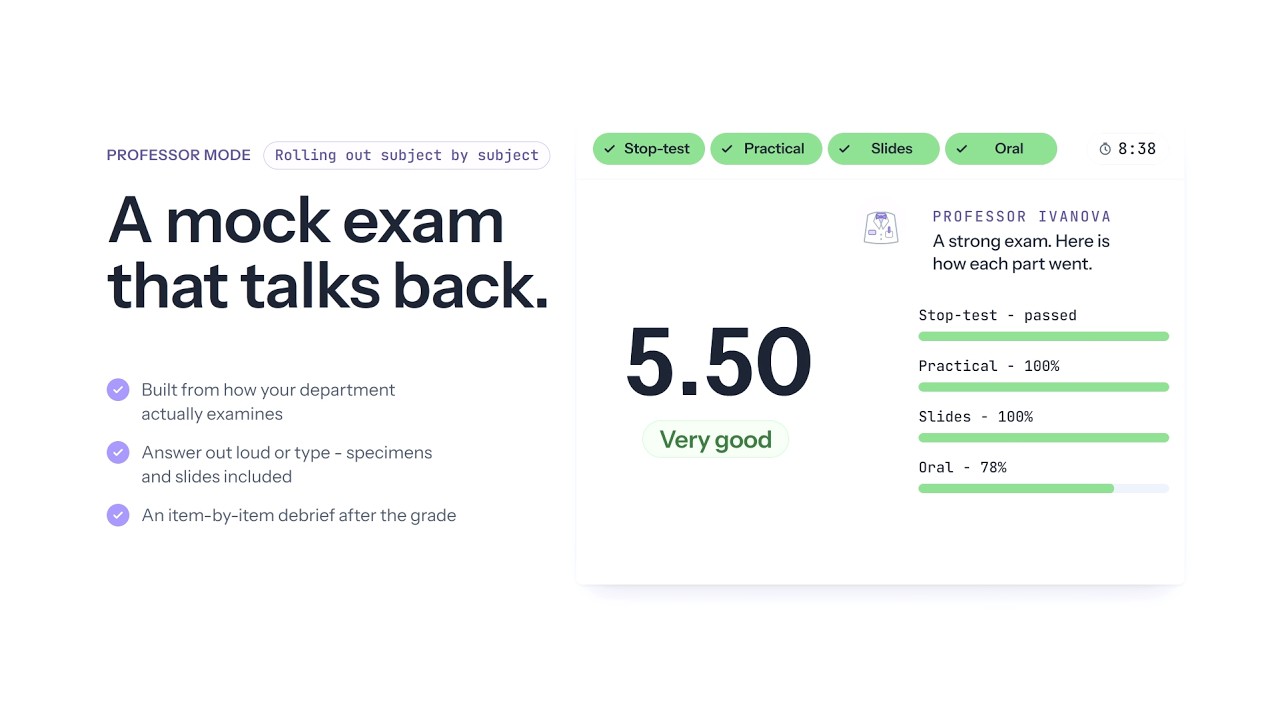
SuperMed presents
SuperPrep
One small piece of material, then questions on all of it, answered from memory with the material out of sight. Pick the grade you are aiming for and SuperPrep shows you exactly what it takes.
Cell-cycle checkpoints
2/12 setsWhat are you aiming for?
The half of the topic most likely to come up, and the core questions on it.
High yield, plus the next layer of detail and harder angles.
Everything in the topic, every question.
- 3-4High yield - The half of the topic most likely to come up, and the core questions on it.
- 4-5Knowledge+ - High yield, plus the next layer of detail and harder angles.
- 6Proficiency - Everything in the topic, every question.
Eight question types, so it is recall rather than recognition. Every set is rescheduled by how you actually did on it.
Professor Ivanova
Which nerve passes through the foramen ovale?
Question 3 of 10 · 8:41
Which nerve passes through the foramen ovale?
Professor modeRolling out subject by subject
A mock exam that talks back.
Your subject’s real exam, rebuilt: the stop-test, the practical, the slides and the oral, in the same order and with the same pass rules. The professor asks, listens to your answer, pushes with a follow-up, and grades you from 2 to 6.
- Built from how your department actually examines
- Answer out loud or type - specimens and slides included
- An item-by-item debrief after the grade
Inside SuperMed · Medicine & Dental Medicine
Every subject, every numbered topic.
Split into the same sections your syllabus is, with notes, figures and SuperPrep on each topic, and a ring beside it showing how much you can actually recall. Every subject
Anatomy
367topics · Years 1-2
1,621 SuperPrep sets
Anatomy I
117topics
470 SuperPrep sets
Medical Biology
105topics
811 SuperPrep sets
Cytology
95topics
380 SuperPrep sets
- Dental
Preclinics of Prosthetic Dental Medicine
75topics · Years 1-2
375 SuperPrep sets
Medical Biology
67topics
264 SuperPrep sets
Cytology & Histology
64topics
257 SuperPrep sets
Medical Chemistry
43topics
173 SuperPrep sets
Medical Physics
41topics
166 SuperPrep sets
Medical Physics
36topics
144 SuperPrep sets
Biophysics
31topics
160 SuperPrep sets
Latin Language
27topics
116 SuperPrep sets
- Dental
Dental Materials
26topics
111 SuperPrep sets
Medical Chemistry
26topics
126 SuperPrep sets
Medical Ethics
2topics
21 SuperPrep sets
- Dental
Computer Science
1topics
5 SuperPrep sets







How a page gets published
The full editorial process- 1
Drafted by a 4th-6th year student, against the syllabus question
- 2
Sourced from the department's own lectures and textbook
- 3
Reviewed line by line by a second student with a top mark
- 4
Published with both names and a date - and correctable
Open to medical students in Bulgaria
Start where the exam starts: question one.
Sign in with your university Google account and pick your year. Each semester has free content for all users - including SuperPrep!