Basic concepts of thermodynamics, entropy, thermodynamic potentials
Subject and basic concepts of thermodynamics. First and second principles of thermodynamics. Definition of entropy, thermodynamic probability and Boltzmann's formula about entropy. Thermodynamic potentials - definitions and properties.
Free notes for topic 01 of the Biophysics syllabus, open without an account. Written by a senior student against the syllabus question and checked line by line by a second student before publishing. How content is made
Updated
Basic concepts of thermodynamics, entropy, thermodynamic potentials: the short version
note
Thermodynamics studies the laws of energy transformation in macroscopic bodies (thermodynamic systems), described by state variables such as V, p, T, U, H and S.
Three kinds of system: isolated (no exchange of energy or matter), closed (energy but not matter) and open (both energy and matter).
State variables depend only on the state, not on the path. Intensive ones (p, T, c) do not depend on system size; extensive ones (V, U, H, S) do.
Zeroth principle: two systems each in equilibrium with a third are in equilibrium with each other. Absolute temperature: T(K) = T(°C) + 273.15.
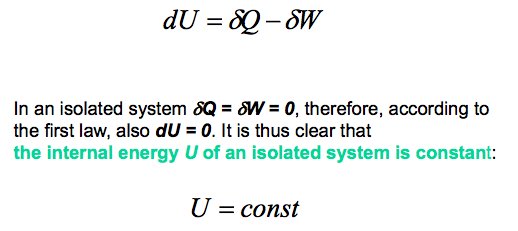
First principle (conservation of energy): dU = δQ - δW. Heat and work depend on the path, internal energy does not. In an isolated system U = const.
Second principle: the entropy of an isolated system only increases until equilibrium, where it is maximal: ΔS = ΔS(sys) + ΔS(sur) ≥ 0. Heat flows from warm to cold, and cannot be fully converted into work: η = W/Q_H = 1 - T_C/T_H.
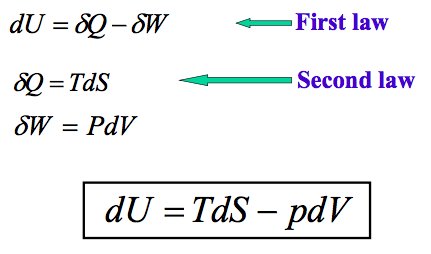
Combined first and second laws: δQ = T·dS, δW = p·dV, so dU = T·dS - p·dV.
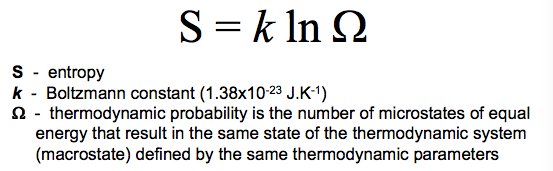
Boltzmann's formula: S = k · ln Ω, with k = 1.38 × 10⁻²³ J·K⁻¹ and Ω the thermodynamic probability (number of microstates of one macrostate). Entropy measures disorder.
Third principle (Nernst): the entropy of a perfect crystal at 0 K is zero (Ω = 1, ln Ω = 0).
Thermodynamic potentials: U(S,V) = F + TS, H(S,p) = U + pV, F(T,V) = U - TS, G(T,p) = F + pV = H - TS. In irreversible processes they decrease when their independent variables are held constant, so the equilibrium state has minimal G (at given p and T).
1. Subject and basic concepts of thermodynamics
note
Thermodynamics is a branch of physics that studies the laws governing the processes of energy transformation in macroscopic bodies, including the effects of temperature. It is applied in everyday life in the internal combustion engine of automobiles (about 25 % efficiency), the turbojet engines of aeroplanes, solar cells and nuclear power plants (production of electricity), the refrigerator and the electric heater.
Macroscopic and microscopic bodies
The distinction between macroscopic and microscopic bodies is made on the basis of their size. A system is microscopic if it is roughly of atomic dimensions and contains only a small number of atoms or small molecules (typically below 100). A system is macroscopic if it is visible to the naked eye and contains a very large number of atoms and molecules, a number that can be expressed through Avogadro's number:
N_A = 6.022 × 10²³
Macroscopic bodies are also called thermodynamic systems. The basic concepts of the subject are the thermodynamic system, its parameters (state variables, for example volume, pressure and temperature), its state, thermodynamic equilibrium, the concepts of energy, heat, work and entropy, and the thermodynamic potentials (Helmholtz free energy, Gibbs free energy).
The thermodynamic system
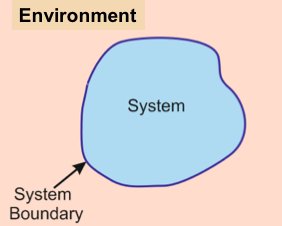
A thermodynamic system is a macroscopic body or region of matter and/or radiation confined in space by a boundary (walls with defined permeabilities). All the space outside the system is known as the surroundings, environment or reservoir. The system is characterised by a set of parameters, such as volume, pressure, temperature and concentration (and also internal energy, enthalpy and entropy), that fully define its state.
Environment (surroundings) around a system, with the system boundary marked
Types of thermodynamic systems
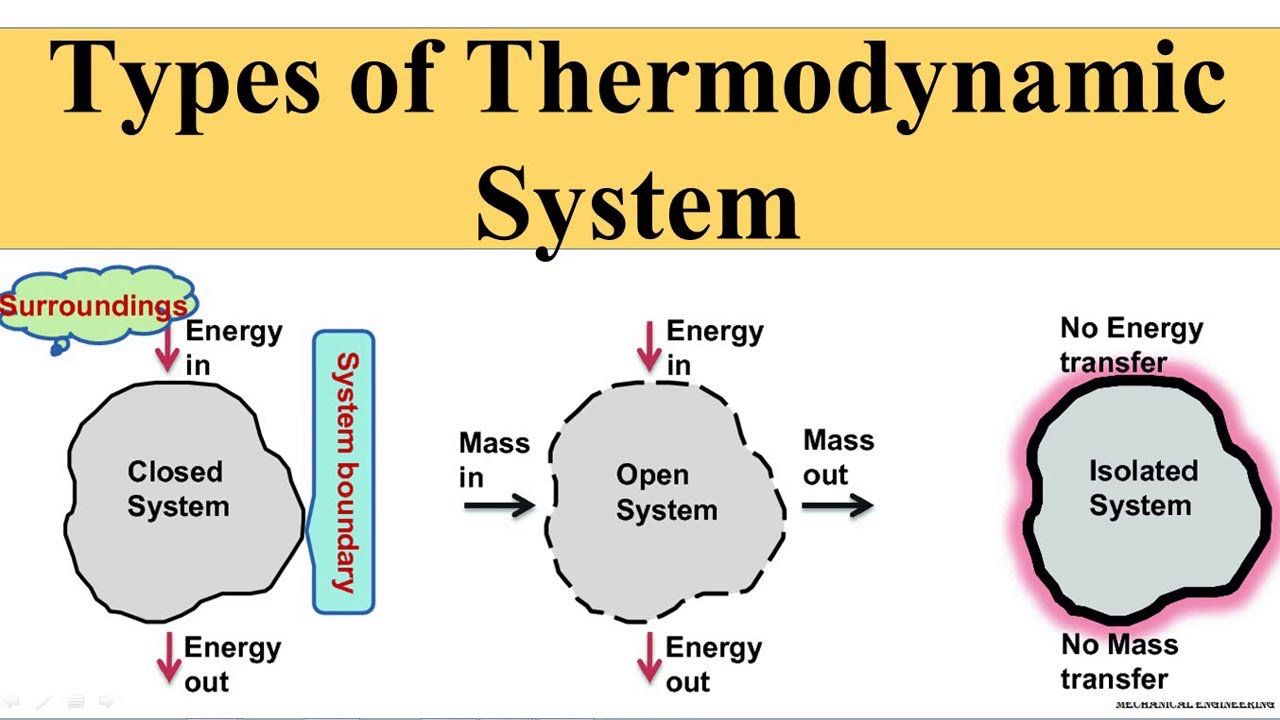
Energy E can cross the boundary in the form of work W or heat Q. Three types of system are distinguished. This is a diagram to be able to draw from memory, with its labels.
Isolated system: no exchange of energy or matter with the surroundings, so both mass and energy remain constant and there is no transfer across the boundary.
Closed system: exchange of energy but no exchange of matter; the mass is fixed and only energy transfer takes place.
Open system: exchange of both matter (mass) and energy across the boundary.
Types of thermodynamic system: closed system (energy in, energy out), open system (mass in, mass out, energy in, energy out) and isolated system (no energy transfer, no mass transfer), with the surroundings and the system boundary
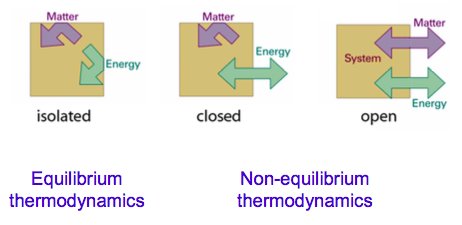
In this course the isolated system belongs to equilibrium thermodynamics, while closed and open systems, which exchange energy, belong to non-equilibrium thermodynamics.
Isolated, closed and open systems with arrows for matter and energy; isolated = equilibrium thermodynamics, closed and open = non-equilibrium thermodynamics
Thermodynamic state and state variables
The thermodynamic state of a system is its condition at a specific time. It is fully defined by a suitable set of experimentally measurable properties known as state variables or thermodynamic parameters, for example volume V, pressure p, temperature T, internal energy U, enthalpy H and entropy S.
State variables depend only on the state that the system is in and not on the path it took to get there. They fall into two categories:
Intensive variables do not depend on the size or mass of the system: pressure, temperature, concentration.
Extensive variables depend on the size and total mass of the system: volume, internal energy, enthalpy, entropy.
Thermodynamic equilibrium
A system is in thermodynamic equilibrium if its parameters do not change with time and there are no net macroscopic flows of matter or energy within the system or between systems created by external sources; the system has no tendency to change state spontaneously. The consequences are:
An equilibrium state can be changed to another state only at the expense of effects from other systems (external forces); equilibrium states can persist for a long time.
For an equilibrium state with a given energy E, the entropy S is greater than that of any other state with the same energy (S = max).
For an equilibrium state with a given pressure p and temperature T, the Gibbs free energy G is smaller than that of any other state with the same p and T (G = min).
In the process of reaching equilibrium, heat is transferred from the warmer object to the cooler one; at equilibrium T₁ = T₂ and the heat transfer is zero.
Open and closed systems, which keep exchanging energy, cannot stay in such a state.
Zeroth principle
The zeroth principle of thermodynamics: if two systems (1 and 2) are each in thermal equilibrium with a third system (3), they are in equilibrium with each other.
Temperature
Temperature is an intensive state variable that measures the warmth (or coldness) of a body. The Celsius scale used in everyday life is defined by two points: melting of ice at 0 °C and boiling of water at 100 °C, measured at atmospheric pressure at sea level (1 atm).
The thermodynamic (absolute) temperature is measured in kelvin [K], and one kelvin is equal to one Celsius degree:
1 K = 1 °C
T(K) = T(°C) + 273.15
Absolute zero (0 K, exactly -273.15 °C) is the lowest possible temperature, at which substances possess no thermal energy (all thermal motions of atoms and molecules come to a stop).
The SI unit of temperature, the kelvin, is named after Lord Kelvin (William Thomson, 1824-1907). It is defined as 1/273.16 of the temperature of the triple point of water.
The triple point of water corresponds to about 0.01 °C (273.16 K) and a pressure of 4.58 mm Hg, at which all three states of water (liquid, vapour and ice) coexist in equilibrium.
2. First principle of thermodynamics: internal energy, heat and work
note
The law of conservation of energy states that energy in nature is neither created nor destroyed. It only passes from one form to another, or from one body to another, so that the sum of all the energies in the system (kinetic, potential, heat and so on) is constant. The first thermodynamic principle expresses this for thermodynamic processes: heat is a form of energy, and thermodynamic processes are subject to the law of conservation of energy.
First law of thermodynamics
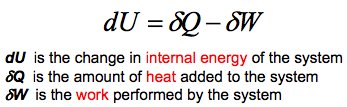
A thermodynamic system can change its internal energy only as a result of performing work or by way of heat exchange with the environment (provided there is no exchange of matter with the environment).
dU = δQ - δW
dU is the change in internal energy of the system.
δQ is the amount of heat added to the system.
δW is the work performed by the system.
The first law: dU = δQ - δW, with dU the change in internal energy, δQ the heat added to the system and δW the work performed by the system
In an isolated system δQ = δW = 0, so according to the first law dU = 0: the internal energy of an isolated system is constant.
U = const
First law dU = δQ - δW; in an isolated system δQ = δW = 0, therefore dU = 0 and U = const
Path dependence
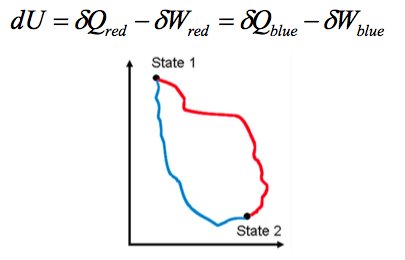
The values of heat and work depend on the process pathway between different states, so heat and work are not state variables or state functions.
Their difference, the internal energy, does not depend on the path between the states and is a function of the system state only.
A system can be driven from one state to another along different pathways with different values of heat and work, but the change of internal energy is the same.
dU = δQ(red) - δW(red) = δQ(blue) - δW(blue)
Two different pathways (red and blue) between State 1 and State 2: dU = δQ_red - δW_red = δQ_blue - δW_blue
Internal energy
Internal energy U is the energy contained by a thermodynamic system. It equals the sum of the energies of all the particles in the system, including their kinetic energy, potential energy, interatomic and intra-atomic energy and so on. It can be changed in three ways: by heat transfer, by work done on or by the system, and by adding or taking away matter. Internal energy is an extensive state variable: it depends only on the state of the system and not on the path taken to reach it.
Heat
Heat Q is the amount of energy transferred from one system to another (to the system) in a heat transfer process, for example by conduction, radiation or convection. Heat is not a state variable, because it depends on the specific path between states.
The heat capacity C is the amount of thermal energy that must be added to a system to raise its temperature by 1 degree:
C = dQ/dT
Q = ∫ C dT (integrated from T₁ to T₂)
Work
Thermodynamic work W performed by a system is a process of energy transfer across the system boundaries, associated with changes of the system's external parameters (the system is displaced by forces acting on it). An example is pressure-volume work:
δW = F · dr = p · (S · dr) = p · dV
F is the force, dr the displacement, S the area acted on, p the pressure and dV the change in volume.
3. Second principle of thermodynamics and entropy
note
Second law
The second law of thermodynamics states that no natural process can occur unless it is accompanied by an increase of entropy in the universe. Several equivalent formulations are used:
The entropy of an isolated system only increases until the system reaches its equilibrium state; at equilibrium the entropy of an isolated system is at its maximum (ΔS > 0 on the way, then S constant and maximal).
Heat cannot spontaneously move from a cold to a warm body; it always moves in the opposite direction, from warm to cold bodies.
All irreversible processes in isolated systems result in an increase of entropy.
ΔS = ΔS(sys) + ΔS(sur) ≥ 0
ΔS(sys) is the entropy change of the system and ΔS(sur) that of the surroundings.
Entropy
Entropy (as defined in the macroscopic way, under reversible conditions) is a measure of a system's thermal energy per unit temperature that is unavailable for doing useful work:
dS = δQ/T
Entropy can be defined in two ways, the macroscopic definition above and the microscopic (statistical) one of Boltzmann (section 4).
Entropy is the thermodynamic parameter that determines the direction of thermodynamic processes, and it is the only parameter that is associated with a direction of time.
Conversion of heat into work
The most important outcome of the second law is that heat cannot be fully converted into work. This sets a theoretical limit on the efficiency of heat engines that no design can exceed. A heat engine is a system that converts heat into mechanical energy which can be used to do mechanical work. The most efficient heat engine was proposed by Sadi Carnot in 1824 and is based on the Carnot cycle; its maximum efficiency is:
η = W/Q_H = 1 - T_C/T_H
η is the efficiency, W the work done, Q_H the heat taken from the hot reservoir.
TH and TC are the absolute temperatures of the hot and cold reservoirs.
Combining the first and second laws
Starting from the first law, dU = δQ - δW, and substituting the second law, δQ = T·dS, and the thermodynamic work, δW = p·dV, gives a single formula (for a reversible process; mtayub adds that it is written for an isothermal, reversible process):
dU = T·dS - p·dV
T·dS is the temperature times the change in entropy; p·dV is the pressure times the change in volume.
This is a key equation to learn.
Combining the first and second laws in a single formula: dU = δQ - δW (first law), δQ = TdS (second law), δW = PdV, giving dU = TdS - pdVChain of equations: dU = δQ - δW (first law), dQ = TdS (second law), dW = pdV (thermodynamic work), dU = TdS - pdV (isothermal, reversible process)
4. Thermodynamic probability, Boltzmann's formula and the third principle
note
Thermodynamic probability
A macrostate is defined by the thermodynamic parameters that describe the system as a whole, for example T, p, V, c and U. A microstate is defined by the parameters of the individual molecules, such as the spatial coordinates and velocity of each molecule in the system. Thermodynamic probability is the number of microstates that result in the same macrostate of the system; it is a measure of the disorder of the system.
Boltzmann's formula for entropy
S = k · ln Ω
S is the entropy.
k is the Boltzmann constant, 1.38 × 10⁻²³ J·K⁻¹.
Ω is the thermodynamic probability: the number of microstates of equal energy that result in the same state of the thermodynamic system (macrostate), defined by the same thermodynamic parameters.
mtayub writes the same formula as S = k log W, with W the number of microstates corresponding to a given macrostate (a key equation).
Boltzmann definition of entropy: S = k ln Ω, with S entropy, k Boltzmann constant (1.38 × 10⁻²³ J·K⁻¹) and Ω the thermodynamic probability
Entropy as a measure of disorder
Greater disorder means greater entropy: greater entropy corresponds to greater disorder of particles. By state of matter, entropy rises in the order solid < liquid < gas.
Energy must be added to systems to maintain order. If left alone, systems tend to proceed towards disorder; this is an entropy-increase effect resulting from the second law.
Living organisms use energy from the sun to create low-entropy conditions and maintain a higher ordering of their structures.
Third principle of thermodynamics
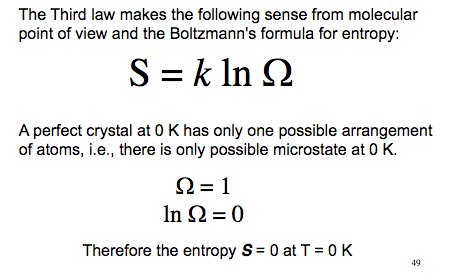
The third principle (Nernst theorem) states that the entropy of a perfect crystal at 0 K is zero. Precisely, the entropy of all perfect crystals at absolute zero is the same, so it may as well be called zero; at 0 K there is no thermal energy.
A perfect crystal has only one possible arrangement of atoms, so at 0 K there is only one possible distribution of energy, that is, only one possible microstate: Ω = 1.
Therefore ln Ω = 0 and, by Boltzmann's formula, S = 0 at T = 0 K.
Merely cooling a body to 0 K is not enough to bring its entropy to zero, because it is still not a perfect crystal. In mtayub's wording, the entropy of a system approaches a constant value as its temperature approaches absolute zero.
Third law from the molecular point of view: S = k ln Ω; a perfect crystal at 0 K has only one possible arrangement of atoms (one microstate), Ω = 1, ln Ω = 0, therefore S = 0 at T = 0 K
5. Thermodynamic potentials: definitions and properties
note
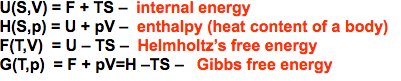
Thermodynamic potentials are scalar functions used to represent the thermodynamic state of a system; they allow additional variables to be measured to get this information. There are four common ones, each with its own natural independent variables. Learn all four to be able to give the individual equations.
U(S,V) = F + TS : internal energy
H(S,p) = U + pV : enthalpy (heat content of a body)
F(T,V) = U - TS : Helmholtz free energy
G(T,p) = F + pV = H - TS = U + pV - TS : Gibbs free energy
U is the internal energy, H the enthalpy, F the Helmholtz free energy and G the Gibbs free energy.
T is the absolute temperature, S the entropy, p the pressure and V the volume.
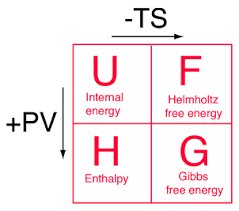
Table of the four potentials: U(S,V) = F + TS internal energy, H(S,p) = U + pV enthalpy (heat content of a body), F(T,V) = U - TS Helmholtz's free energy, G(T,p) = F + pV = H - TS Gibbs free energySquare relating the potentials: U (internal energy), F (Helmholtz free energy), H (enthalpy), G (Gibbs free energy); moving along the top row subtracts TS, moving down a column adds PV
Helmholtz and Gibbs free energy
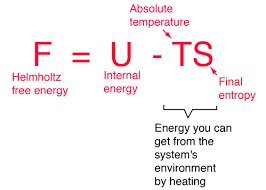
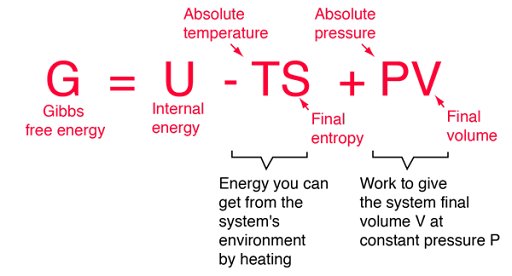
In F = U - TS, the term TS is the absolute temperature times the final entropy; F is the energy you can get from the system's environment by heating (as given on the mtayub slide).
Helmholtz free energy F = U - TS: F Helmholtz free energy, U internal energy, T absolute temperature, S final entropy; the term is the energy you can get from the system's environment by heating
In G = U - TS + pV, the pV term is the work needed to give the system its final volume V at constant pressure p.
Gibbs free energy G = U - TS + PV: absolute temperature T, final entropy S, absolute pressure P, final volume V; TS is the energy you can get from the environment by heating, PV the work to give the system its final volume at constant pressure
Free and bound energy
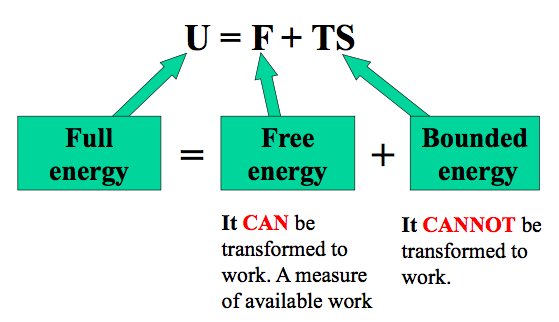
The internal energy splits into two parts: U = F + TS. The full energy U equals the free energy F plus the bound energy TS. Free energy can be transformed into work and is a measure of available work; bound energy cannot be transformed into work.
Full energy U = F + TS: free energy F can be transformed to work (a measure of available work), bounded energy TS cannot be transformed to work
Behaviour in irreversible processes
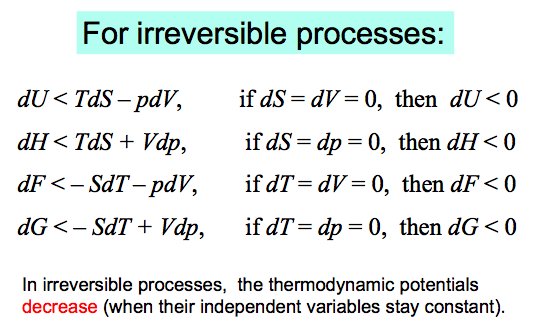
All processes in nature lead to a decrease of the thermodynamic potential and an increase of entropy; this continues until the equilibrium state is reached. In irreversible processes the thermodynamic potentials decrease when their independent variables stay constant:
dU < T·dS - p·dV; if dS = dV = 0, then dU < 0.
dH < T·dS + V·dp; if dS = dp = 0, then dH < 0.
dF < -S·dT - p·dV; if dT = dV = 0, then dF < 0.
dG < -S·dT + V·dp; if dT = dp = 0, then dG < 0.
For irreversible processes: dU < TdS - pdV, dH < TdS + Vdp, dF < -SdT - pdV, dG < -SdT + Vdp; if the pair of independent variables is constant, the potential decreases (dU, dH, dF, dG < 0)
The equilibrium state at given pressure and temperature is therefore the state of minimal Gibbs free energy, and at a given energy the state of maximal entropy.
All 30 Biophysics topics · exam study support, not clinical guidance. SuperMed is not affiliated with the Medical University of Sofia.
Start free. No card needed.
Every account starts free, with free topics in Cytology, Medical Biology, Anatomy, Biophysics, Pharmacology and Preclinics of Pediatric Dental Medicine. Super opens the rest. Super is €15 a month.