



The launch film
SuperMed in two minutes
Two minutes on SuperMed: every numbered topic of the syllabus written out and reviewed, SuperPrep recall practice at the grade you are aiming for, Professor mode mock exams, and the rest of the toolbox.
Also on YouTube, on the SuperMed channel.
What the film shows
- The pile every student knows - lectures, textbooks, last year’s notes, group chats - and the only question that matters: which of it is on the exam.
- Every subject and every numbered topic, in the syllabus’s own order. Cytology topic 34, the cell cycle, opens.
- Its note, written out in full and taken through the four editorial steps: drafted, sourced, reviewed line by line, published.
- SuperPrep: pick the grade you are aiming for, read one small piece of material, then answer every question on it from memory.
- Why that works - the research below - and spaced review: each set comes back before you forget it, rescheduled by how you actually did.
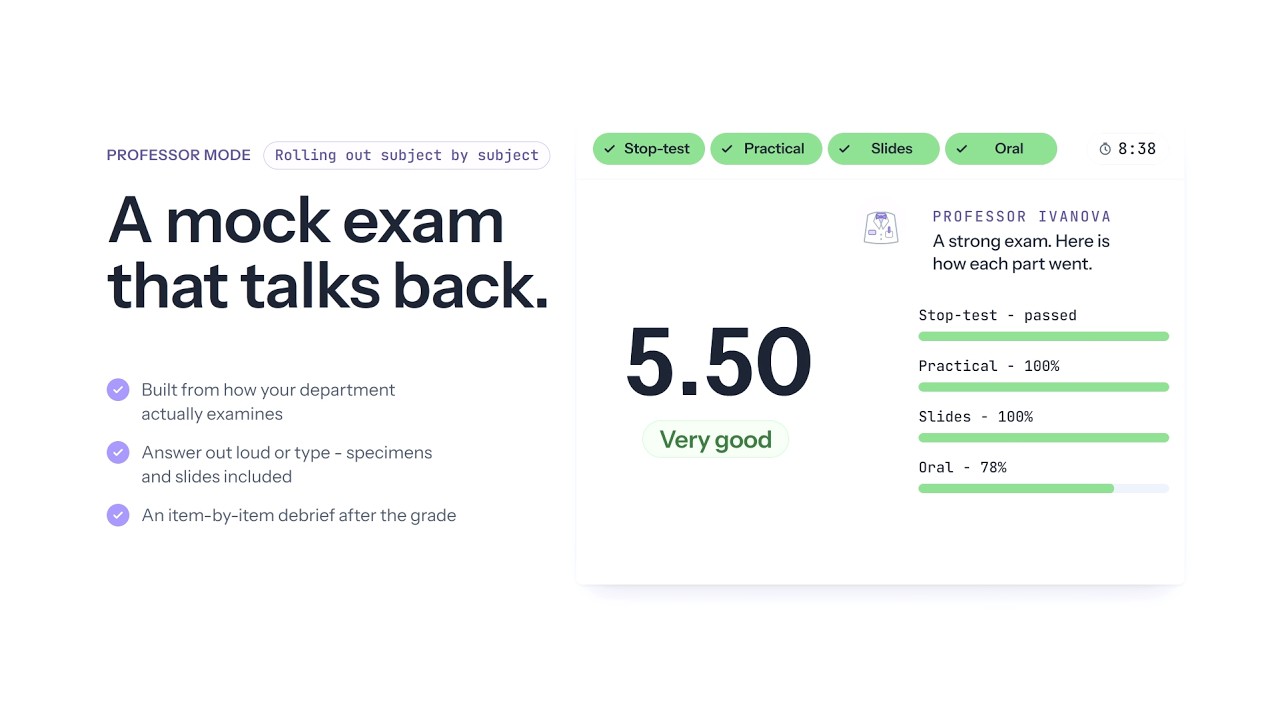
- Professor mode: a mock exam that asks, listens, checks your slides, pushes with a follow-up, and grades you from 2 to 6.
- Your year: every exam date for your group, counted down.
- Flashcards with spaced repetition, clinical questions, and real slides at every magnification.
- Making it yours: an avatar, and a light or dark theme.
- Studying with friends: weekly leaderboards for your year and your university, and Medicine against Dental Medicine, scored per active student.
- Where to start: question one, free.
The research it cites
SuperPrep is built on the two study techniques with the strongest evidence behind them: practice testing (answering from memory rather than re-reading) and spaced practice.
- A week later: 61% against 40%. Students who had been tested on a passage recalled 61% of it a week later; students who had re-read it recalled 40%. Roediger & Karpicke (2006), “Test-enhanced learning”, Psychological Science 17(3), 249-255. doi:10.1111/j.1467-9280.2006.01693.x
- Six months later, in doctors: 39% against 26%. Paediatric and emergency medicine residents taught by repeated testing scored 39% on a final test about six months on; those taught by repeated study, 26%. Larsen, Butler & Roediger (2009), Medical Education 43(12), 1174-1181. doi:10.1111/j.1365-2923.2009.03518.x
- Two of ten techniques rated high utility. A review of ten common study techniques rated only practice testing and distributed practice as high utility. Dunlosky et al. (2013), Psychological Science in the Public Interest 14(1), 4-58. doi:10.1177/1529100612453266
Start free. No card needed.
Every account starts free, with Urology open in full and free topics in Cytology, Medical Biology, Anatomy, Biophysics, Medical Genetics, Pharmacology, Internal Medicine (Clinical), Preclinics of Prosthetic Dental Medicine, Preclinics of Pediatric Dental Medicine, Dental Prophylaxis, Diagnostic Imaging, Dental Allergology, Dental Implantology, Physiotherapy, Cytology & Histology, Anatomy I and Medical Biology. Super opens the rest. Super is €14.99 a month.