



Dental Prophylaxis · Year 4 · Medical University of Sofia

01

The role of microorganisms in etiology of dental caries

Free notes for topic 01 of the Dental Prophylaxis syllabus, open without an account. Written by a senior student against the syllabus question and checked line by line by a second student before publishing. How content is made

Updated

Introduction to the microbial role in caries

note

Dental caries is a process that takes place in the dental biofilm on a tooth surface. The disease is the combination of the microbial metabolic activity that is invisible to the clinician and the carious lesion that develops as its result, and that lesion is clinically apparent. This note covers the micro-organisms that take part in the process: which ones are involved, how they reach the tooth, how they attach and what they do with sugar. The sugar itself, the enamel and the saliva are covered in their own notes.

Caries requires three interacting factors: a susceptible tooth, cariogenic bacteria and fermentable carbohydrates. The absence of any one of them greatly reduces the risk. The mouth can never be made sterile, and its temperature of about 37 degrees Celsius favours the growth of bacteria that turn sugar into acid. For caries to develop, two conditions must be met. Acid-producing bacteria must be present, and the acid they produce must not be washed away from the place where the lesion is forming. The dental biofilm meets both conditions, because it holds the bacterial colonies in a gel-like matrix of glucan that protects them from being flushed away, neutralised or affected by antimicrobials in the saliva.
Caries as a process and as a disease

note

Dental caries is a localised chemical dissolution of the tooth surface. It is caused by acids that the biofilm micro-organisms produce when they ferment dietary carbohydrates. The destruction can affect enamel, dentine and cementum. The disease process starts in the biofilm covering the tooth, while the signs of demineralisation, which are its consequence, are seen on the hard tissues.

Caries is a multifactorial disease. Primary factors are the qualities of the enamel, the micro-organisms, fermentable carbohydrates and time. Additional, secondary factors are saliva and time. Behavioural, socio-economic and hereditary factors influence the disease as well. Different people have different combinations of causal factors, and caries develops only when the combination of factors is sufficient.

The micro-organisms are one part of this set. They are a necessary but not sufficient cause. Their metabolism is what turns the carbohydrates into acid, and that acid is what starts the destruction.

Caries develops from an imbalance between risk factors and protective factors. The process existed for a long time before the lesion became visible, so the lesion is only the sign of a process that was already under way. Family environment, social group and country, individual behavioural habits, age and the state of the oral environment all act on the process, at the level of the tooth surface, of the oral environment and of the individual. The introduction of time into the aetiology changed the understanding of caries, because it is the frequency and duration of exposure to acid, rather than a single event, that decides whether a lesion forms.

Accounts of the disease differ on one point. Some describe dental caries as a diet-related, infectious and transmissible disease. Others describe it as a polymicrobial disease caused by a consortium of pathobionts, which are normally present at low levels in healthy mouths, and state that it is not infectious. Both descriptions are given here so that the reader can see the disagreement. In either description, the biofilm micro-organisms are the immediate cause of the acid that starts the carious process.

Micro-organisms in the mouth

note

The mouth holds more than 700 species of micro-organisms. Conditions in the oral cavity offer both a friendly habitat, where many kinds of bacteria can settle and survive, and a hostile environment for microbial growth, because of saliva, the flow of fluid and the constant removal of loose cells.

Bacteria colonise the mouth from birth. The infant acquires its first micro-organisms from the mother during the birth process. Further bacteria come from the atmosphere, from food, from close human contact and from animals, such as pets. The mutans streptococci are transmitted vertically, from mother to baby in the period just before and after birth, and also by close mouth-to-mouth contact such as kissing or sharing a spoon during feeding. If they arrive at birth they reside in low numbers in reservoirs such as the tonsils and the dorsum of the tongue, until the teeth erupt. The bacteria then colonise the interfaces between saliva and the soft tissues of the gingiva, tongue, cheeks and tonsils, and the hard surfaces of erupted teeth. Meanwhile, other bacteria settle in protected sites such as the interproximal spaces, along the gingiva and in pits and fissures. The mucosal surfaces of the tongue and tonsils act as reservoirs for the micro-organisms that later form the dental biofilm, including those related to disease.

Not every micro-organism in the biofilm can cause caries. Those that can are called cariogenic. Two bacterial genera are of special interest in cariogenesis: the mutans streptococci, which lead in the early stages, and the lactobacilli, which are involved in the later stages. A cariogenic bacterium must have caries-promoting properties. It must be able to:

  • transport fermentable sugars rapidly and convert them to acid (acidogenic capacity);
  • produce extracellular and intracellular polysaccharides, which form the biofilm matrix;
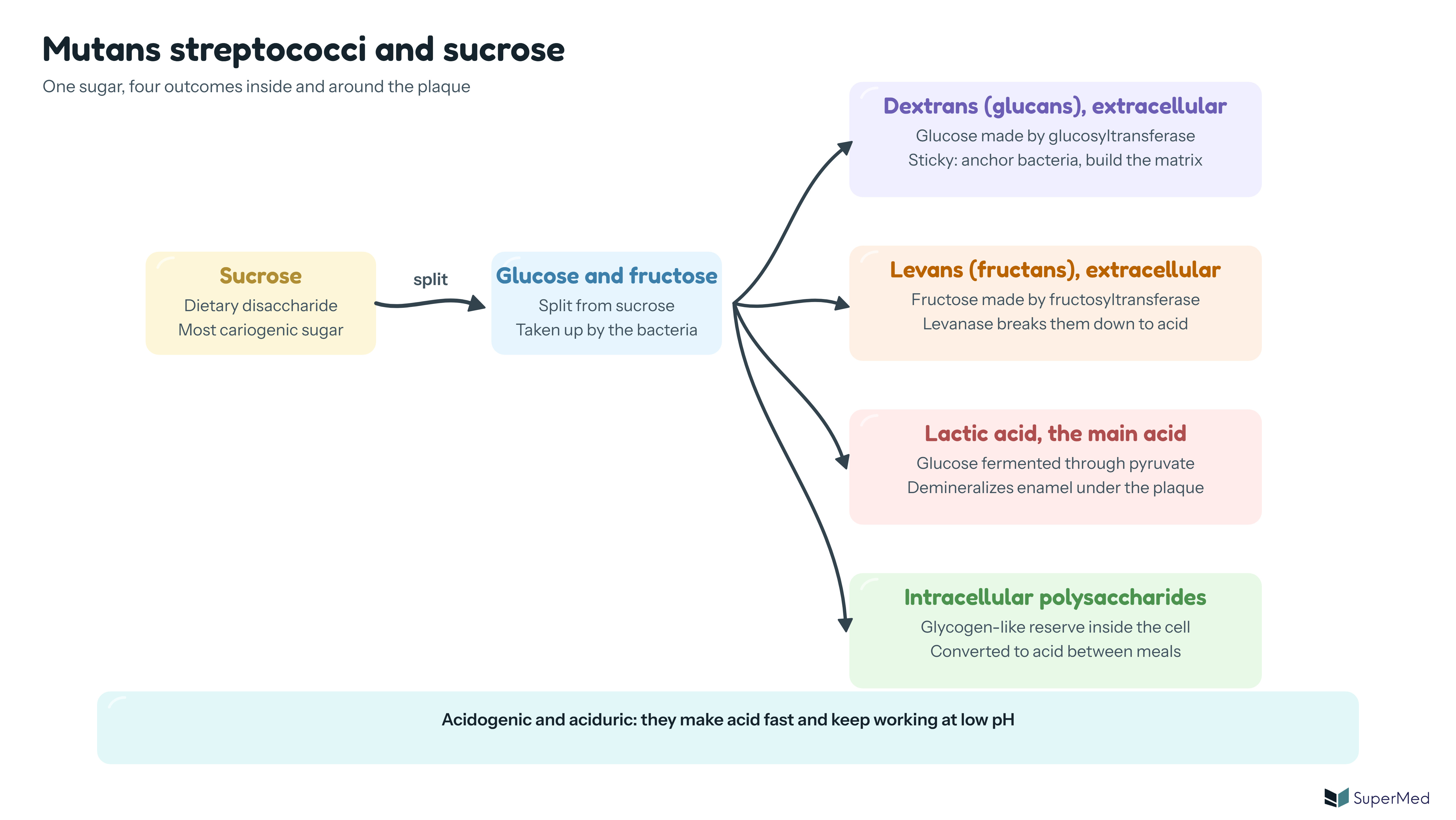
  • keep metabolising sugar at a low pH (aciduric capacity).

Intracellular polysaccharides serve as an internal energy store. When no sugar is available, the bacteria break them down to acid, so acid production continues between meals.

Mutans streptococci

note

The mutans streptococci, mainly Streptococcus mutans and Streptococcus sobrinus, are the most cariogenic group. They play the leading role in the early stages of the carious process, and they are most often found in lesions on smooth surfaces. They are not among the pioneer organisms of the mouth. They begin to colonise only after the first tooth has erupted, during a period known as the window of infectivity, which falls at 19-31 months of age. The timing of this colonisation is closely linked to the level of caries risk the child will later have.

S. mutans has four properties that make it cariogenic:

  • Adhesiveness. It adheres to enamel in two ways. The first is sucrose-independent: it attaches to the acquired pellicle through extracellular adhesins on its fimbriae, and it can ferment lactose. The second is sucrose-dependent: in the presence of sucrose it forms water-insoluble extracellular glucan, which allows tight adhesion and the build-up of further colonies.
  • Acid production. It ferments sugars directly and very quickly. Its main product is lactic acid. Starch is first broken down by salivary amylase to maltose, which the bacterium then ferments to acid with its own maltase.
  • Relation to sucrose. It carries a sucrose-specific enzyme, glucosyltransferase, which uses sucrose to build extracellular and intracellular polysaccharides.
  • Aciduricity. It survives at low pH and in fact grows and metabolises better in acid. This is the key property behind its role in caries.

The mutans streptococci are only necessary, not sufficient, for caries. Their numbers in saliva and plaque are used as an indicator of the amount of acid being produced and of the carbohydrate load in the mouth.

Mutans streptococci converting sucrose into extracellular polysaccharides: sucrose is split into glucose and fructose, glucose forms dextrans with the enzyme glycosyltransferase, and fructose forms levans

Sucrose, glucans, levans and intracellular polysaccharides

note

Sucrose is the sugar that S. mutans uses most. When the bacterium metabolises sucrose, the glucose and fructose parts are handled in different ways.

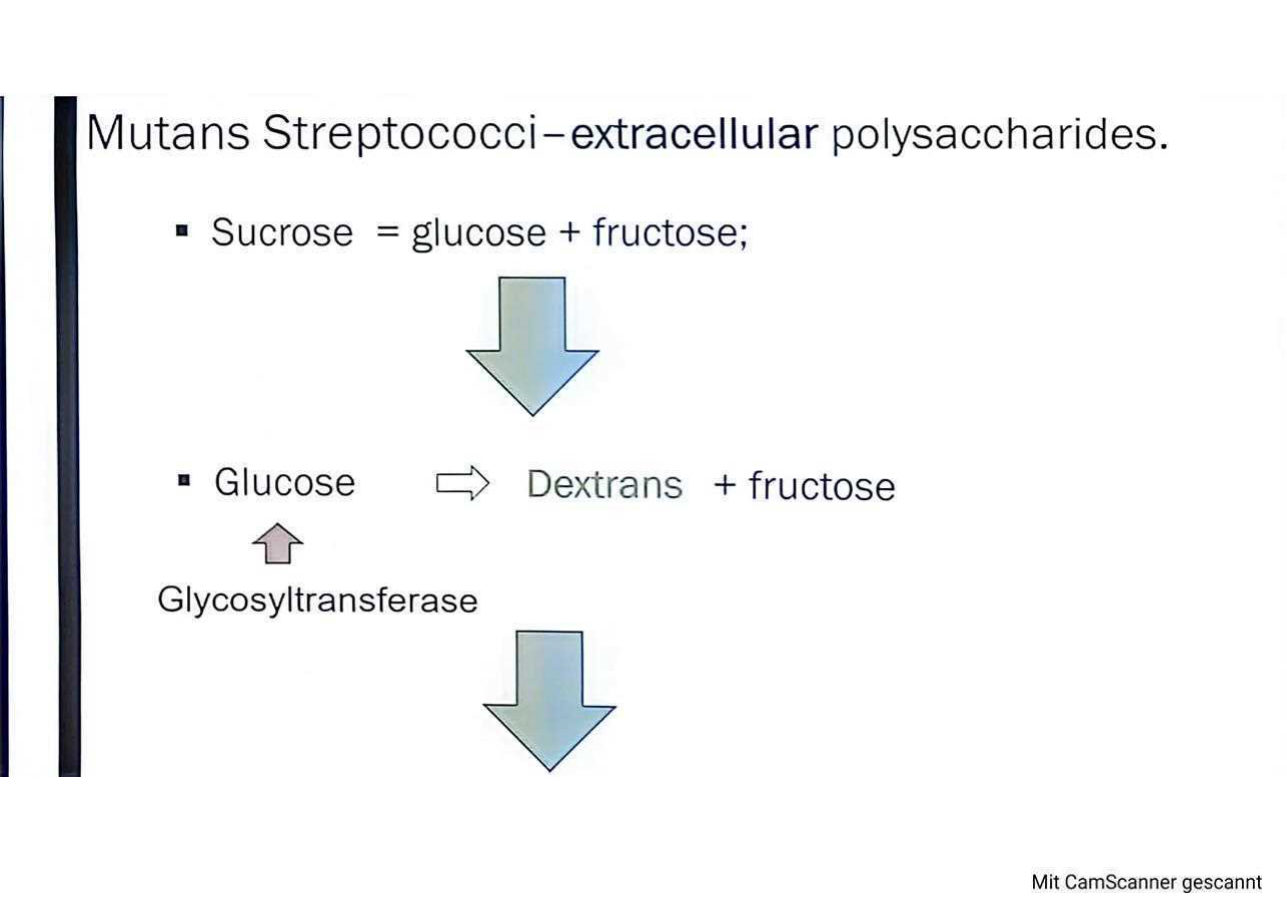
  • Glucans (dextrans). Glucosyltransferase converts the glucose part of sucrose into extracellular glucans. These are viscid, insoluble and strongly adhesive. They anchor the bacteria to the pellicle, make the adhesion of one micro-organism to another easier, and build the matrix that holds the biofilm together and keeps it growing. The dense mass they form stops saliva from entering the biofilm and stops the plaque from becoming alkaline. For the same reason, the acids produced inside the biofilm cannot leave it, so they stay close to the enamel for a long time and demineralise it.
  • Levans (fructans). Fructosyltransferase builds soluble extracellular levans from the fructose part. Levans are highly labile. Levanase and levan hydrolase break them down to acids soon after they form, which increases the acid in the biofilm. Levans also serve as a stored food source for any bacterium that has levanase, so the bacteria keep metabolising even when no new carbohydrate comes from the diet.
  • Intracellular polysaccharides. These are glycogen-like stores made from glucose, maltose or sucrose. Under the microscope they appear as granules inside the cell. Between meals, when there is no fermentable carbohydrate, the bacteria break them down to acids, and these acids leave the cell and add to the acid load of the plaque.
Mutans streptococci extracellular polysaccharides: sucrose is broken into glucose and fructose, glucose is converted to dextrans by glycosyltransferase

Other fermentable carbohydrates also reach the bacteria. Monosaccharides and disaccharides are metabolised directly. Polysaccharides, including starch, must first be broken down by salivary amylase to maltose, which the bacteria then ferment. For that reason, the total intake of sugar, its consistency and how often it is eaten all matter, and these are covered in the note on fermentable carbohydrates.

Other streptococci and lactobacilli

note

Several other streptococci have caries-promoting features, but they are less cariogenic than S. mutans.

  • *Streptococcus sanguinis* metabolises sucrose and produces acid quickly, and it can colonise all tooth surfaces. It cannot survive in an acid environment, and it cannot synthesise glucans from glucose, so it has no role in attaching other micro-organisms to the tooth. It is displaced by the streptococci that tolerate acid.
  • *Streptococcus salivarius* metabolises sucrose and produces acid quickly, but it cannot synthesise dextrans from sucrose. It forms mainly levans, which are less relevant to the carious process. It also has a specific affinity for the tongue rather than the enamel.

Lactobacilli are acidogenic and aciduric as well, and they metabolise sucrose, but they produce only minimal amounts of dextrans. They cannot attach to smooth enamel and develop mainly in defects, fissures and pits. Although they produce acid rapidly, their cariogenic potential is not great. They act at a later stage, once the enamel or dentine has begun to cavitate, and their numbers rise after the dentine has been invaded. Their presence is a good indicator of the total carbohydrate intake. They are regarded as opportunistic rather than initiating organisms, and they are found in large numbers in children. Their low-pH environment often suppresses the continuity of colonisation by S. mutans. In supragingival plaque, streptococci and lactobacilli dominate, and they can lower the plaque pH and cause decalcification, seen as white spot lesions.

Hypotheses about the role of the biofilm flora

note

Three hypotheses have been proposed to explain how the biofilm micro-organisms cause caries.

  • The specific plaque hypothesis holds that only a few organisms out of the whole flora are actively involved in the disease. It would make prevention aimed at specific bacteria, for example by immunisation, a logical strategy.
  • The non-specific plaque hypothesis holds that the carious process is caused by the overall activity of the whole microflora. It follows that all plaque should be disturbed, and mechanical plaque control with the toothbrush is the logical measure.
  • The ecological plaque hypothesis holds that organisms associated with disease may be present even at sound sites. Demineralisation results from a shift in the balance of the resident microflora, driven by a change in the local environment. Frequent sugar intake, or a fall in sugar clearance when salivary secretion is low, encourages the growth of acidogenic and aciduric species. This hypothesis is not limited to the mutans streptococci, and it takes into account every factor that disturbs the balance of the flora. It is the basis of the strategies used for caries prevention.

Summary

note

  • Caries is a biofilm-dependent process, and the biofilm micro-organisms are its immediate cause.
  • The key cariogenic bacteria are the mutans streptococci, which are acidogenic, aciduric and adhesive, and which colonise the mouth after tooth eruption during the window of infectivity.
  • S. mutans uses sucrose to build sticky glucans and levans and to store intracellular polysaccharides, which all add to the acid load of the plaque.
  • Other streptococci and the lactobacilli contribute less, and the lactobacilli act mainly at the cavitation stage.
  • The ecological hypothesis explains caries as a shift in the balance of the flora, and that is the basis for prevention.

All 27 Dental Prophylaxis topics · exam study support, not clinical guidance. SuperMed is not affiliated with the Medical University of Sofia.

Start free. No card needed.

Every account starts free, with Urology open in full and free topics in Cytology, Medical Biology, Anatomy, Biophysics, Medical Genetics, Pharmacology, Preclinics of Prosthetic Dental Medicine, Preclinics of Pediatric Dental Medicine, Dental Prophylaxis, Dental Allergology, Dental Implantology, Physiotherapy, Cytology & Histology, Anatomy I and Medical Biology. Super opens the rest. Super is €14.99 a month.

Create a free account