


MCS (Disaster Medicine) · Year 2 · Medical University of Sofia

01

Common characteristic of disaster situations. Definition, criteria and classification

Common characteristic of disaster situations. Definition, criteria and classification.

Free notes for topic 01 of the MCS (Disaster Medicine) syllabus, open without an account. Written by a senior student against the syllabus question and checked line by line by a second student before publishing. How content is made

Updated

Summary

note

  • A disaster is a serious disruption of the functioning of a community or society that exceeds its ability to cope with its own resources, so that external assistance is needed.
  • It arises when a hazard meets a vulnerable population with too little capacity or too few measures to reduce the risk.
  • Common features: sudden onset, collective community-wide level, damaged infrastructure, loss of hospitals and healthcare services, a disrupted recovery environment, vulnerable people.
  • Entry criteria (EM-DAT): 10 or more people killed, 100 or more affected, a declared state of emergency, or a call for international assistance. Any one is enough.
  • Classification: two generic groups, natural and technological (plus complex disasters such as famine). Natural disasters are split into geophysical, meteorological, hydrological, climatological and biological sub-groups.
1. Common characteristics of disaster situations

note

Disasters occur at the collective, community-wide level. They permanently reshape the communities where they happen.

  • Infrastructure may be damaged.
  • The people affected are often left without hospitals and healthcare services.
  • The recovery environment is disrupted and unfamiliar.
  • People go through the painful realisation that nothing will be exactly the same again, and they are vulnerable.
  • Some members of the community will move away.

The characteristics usually listed in short form are: sudden onset, damage to infrastructure and human life, severity, unpredictability, and people becoming vulnerable.

2. Definition of a disaster

note

The definition used for a disaster is often as varied as the discipline using it, because of the multidisciplinary nature of disaster.

The WHO definition

The World Health Organization (WHO) defines a disaster as "a sudden ecological phenomenon of sufficient magnitude to require external assistance".

The emergency medicine definition

A more focused definition, often used by practitioners of emergency medicine, says a disaster exists when the number of patients presenting within a given time period is such that the emergency department cannot provide care for them without external assistance.

The EM-DAT definition

A disaster can also be defined as "a serious disruption in the functioning of the community or a society causing widespread material, economic, social or environmental losses which exceed the ability of the affected society to cope using its own resources". A disaster results from the combination of hazard, vulnerability and insufficient capacity or measures to reduce the potential chances of risk. A disaster happens when a hazard impacts on a vulnerable population and causes damage and disruption.

What all definitions share

  • Disasters are not defined by a specific number of casualties but by the event itself and the venue in which it occurs.
  • Disasters tend to be caused by nature or by humans themselves.
  • In all definitions, a disaster is something outside the normal experience of daily life that requires a change from the daily management style and thinking.

The EM-DAT database and the data it records

note

EM-DAT (Emergency Events Database) data include the following main information.

FieldMeaning
Disaster numberA unique number for each event: 8 digits, 4 for the year and 4 for the disaster number (for example 1995-0324)
CountryThe country (or countries) in which the disaster occurred
Disaster groupTwo main groups: natural and technological. A third category, complex disasters, was added to include specific events (famine) not directly linked to a natural hazard
Disaster typeDescription of the disaster according to a pre-defined classification
DateWhen the disaster occurred, entered as Month/Day/Year
DeathNumber of people who lost their life because the event happened
MissingNumber of people whose whereabouts since the disaster are unknown and who are presumed dead (official figure when available)
Total deathsSum of death and missing
InjuredPeople suffering from physical injuries, trauma or an illness requiring immediate medical assistance as a direct result of the disaster
HomelessNumber of people whose house is destroyed or heavily damaged and who therefore need shelter after the event
AffectedPeople requiring immediate assistance during a period of emergency, that is basic survival needs such as food, water, shelter, sanitation and immediate medical assistance
Total affectedSum of injured, homeless and affected
Estimated damageThe amount of damage to property, crops and livestock, given in US$ ('000). The registered figure is the damage value at the moment of the event, so figures are true to the year of the event

When a disaster occurs, the related information is entered at three different levels: the event/disaster level, the country (or countries) level, and the source level.

3. Criteria of a disaster

note

For a disaster to be entered into the database, at least one of the following criteria must be fulfilled:

  1. Deaths: ten (10) or more people reported killed.
  2. Affected: one hundred (100) or more people reported affected (injured or made homeless).
  3. Declaration: the country declares a state of emergency.
  4. International assistance: the country makes a call (appeal) for international assistance.

Secondary criteria are taken into account when figures are missing. An example of a secondary criterion is a consequence of an earthquake, such as the disruption of electrical power.

4. Classification of disasters

note

EM-DAT distinguishes two generic categories of disaster: natural and technological. The natural category is divided into 5 sub-groups, which cover 15 disaster types and more than 30 sub-types. The technological category is divided into 3 sub-groups, which cover 15 disaster types. Each group therefore covers different disaster main types, and each main type has different sub-types.

Natural disasters can be divided into six groups (biological, geophysical, meteorological, hydrological, climatological and extra-terrestrial), and four important divisions are atmospheric, terrestrial, aquatic and biological.

Natural disasters

note

Floods, volcanoes and wildfires are examples of natural disasters. A natural disaster is a catastrophic event caused by natural forces.

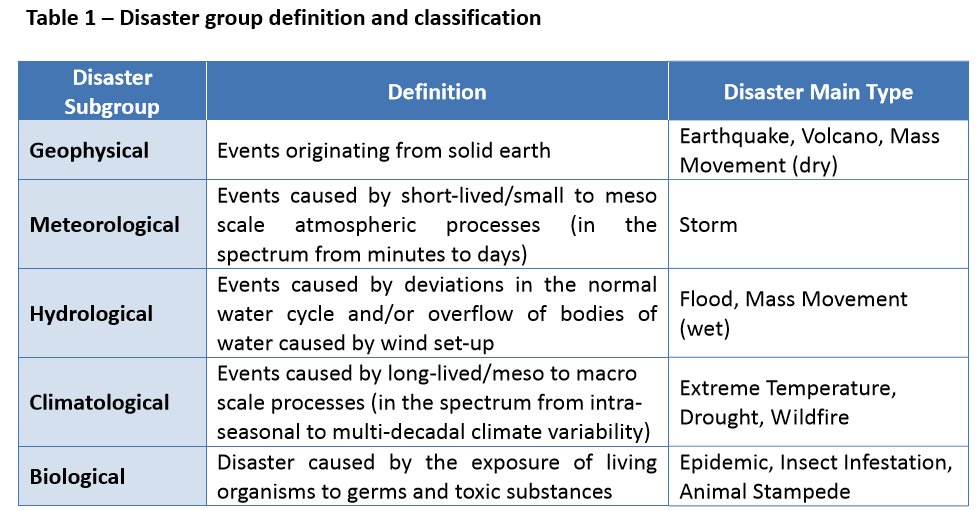
Table 1, disaster group definition and classification: Geophysical (events originating from solid earth: earthquake, volcano, mass movement dry), Meteorological (short-lived small to meso scale atmospheric processes, minutes to days: storm), Hydrological (deviations in the normal water cycle and/or overflow of bodies of water caused by wind set-up: flood, mass movement wet), Climatological (long-lived meso to macro scale processes, intra-seasonal to multi-decadal climate variability: extreme temperature, drought, wildfire), Biological (exposure of living organisms to germs and toxic substances: epidemic, insect infestation, animal stampede)
Sub-groupDefinitionMain types
GeophysicalEvents originating from solid earthEarthquake, volcano, mass movement (dry)
MeteorologicalEvents caused by short-lived, small to meso scale atmospheric processes (in the spectrum from minutes to days)Storm
HydrologicalEvents caused by deviations in the normal water cycle and/or overflow of bodies of water caused by wind set-upFlood, mass movement (wet)
ClimatologicalEvents caused by long-lived, meso to macro scale processes (in the spectrum from intra-seasonal to multi-decadal climate variability)Extreme temperature, drought, wildfire
BiologicalDisaster caused by the exposure of living organisms to germs and toxic substancesEpidemic, insect infestation, animal stampede
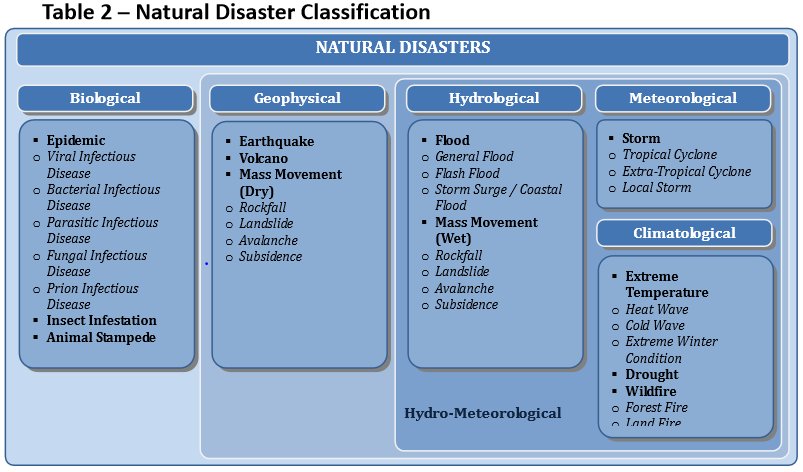
Table 2, natural disaster classification tree. Biological: epidemic (viral, bacterial, parasitic, fungal, prion infectious disease), insect infestation, animal stampede. Geophysical: earthquake, volcano, mass movement dry (rockfall, landslide, avalanche, subsidence). Hydrological: flood (general flood, flash flood, storm surge or coastal flood), mass movement wet (rockfall, landslide, avalanche, subsidence). Meteorological: storm (tropical cyclone, extra-tropical cyclone, local storm). Climatological: extreme temperature (heat wave, cold wave, extreme winter condition), drought, wildfire (forest fire, land fire). Hydrological and meteorological together form the hydro-meteorological group

The sub-types in the classification tree are:

  • Biologicalepidemic (viral, bacterial, parasitic, fungal and prion infectious disease), insect infestation, animal stampede.
  • Geophysicalearthquake; volcano; mass movement (dry) with rockfall, landslide, avalanche and subsidence.
  • Hydrologicalflood (general flood, flash flood, storm surge or coastal flood); mass movement (wet) with rockfall, landslide, avalanche and subsidence.
  • Meteorologicalstorm (tropical cyclone, extra-tropical cyclone, local storm).
  • Climatologicalextreme temperature (heat wave, cold wave, extreme winter condition), drought, wildfire (forest fire, land fire).

The hydrological and meteorological groups together make up the hydro-meteorological group in the diagram.

Technological (man-made) disasters

note

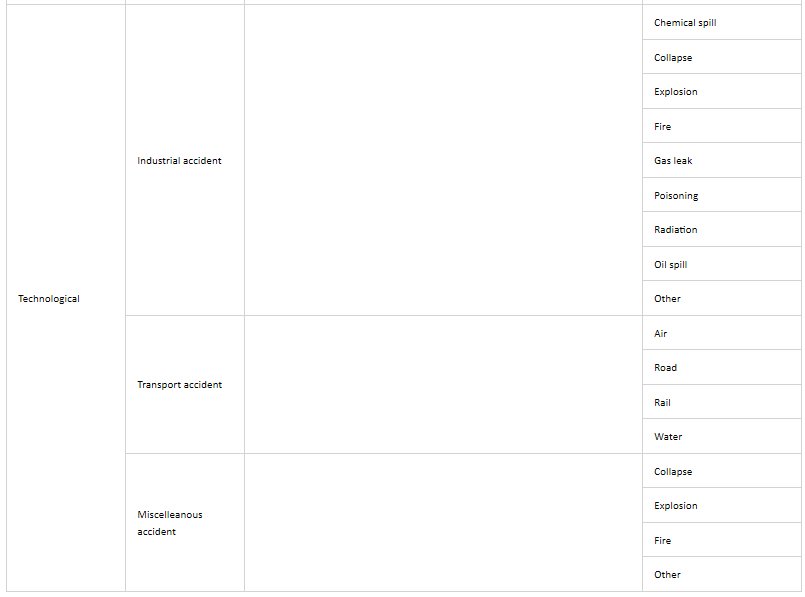
A technological, or man-made, disaster is a harmful event caused by human actions or mistakes. The EM-DAT table groups them into three sub-groups:

Sub-groupTypes
Industrial accidentChemical spill, collapse, explosion, fire, gas leak, poisoning, radiation, oil spill, other
Transport accidentAir, road, rail, water
Miscellaneous accidentCollapse, explosion, fire, other
EM-DAT technological disaster table: Industrial accident (chemical spill, collapse, explosion, fire, gas leak, poisoning, radiation, oil spill, other), Transport accident (air, road, rail, water), Miscellaneous accident (collapse, explosion, fire, other)

The same grouping is often taught in broader terms:

  • Industrial accidentschemical spills, nuclear incidents, industrial explosions.
  • Transportation accidentsplane crashes, train derailments, shipwrecks.
  • Environmental pollutioncontamination of air, water or soil.
  • Terrorist attacksbombings, chemical attacks, cyber-terrorism.
  • Armed conflictswars and civil unrest.

Complex disasters

note

A third category, complex disasters, was added in EM-DAT for specific events such as famine that are not directly linked to a natural hazard.

All 37 MCS (Disaster Medicine) topics · exam study support, not clinical guidance. SuperMed is not affiliated with the Medical University of Sofia.

Start free. No card needed.

Every account starts free, with Medical Ethics, Urology and Computer Science open in full and free topics in Cytology, Latin Language, Medical Chemistry, Medical Physics, Medical Biology, Anatomy, Biophysics, Medical Psychology, MCS (Disaster Medicine), Physiology, Biochemistry, Social Medicine, Medical Genetics, Pharmacology, Pathophysiology, Microbiology, Internal Medicine, Nephrology, Cardiology, Pulmonology, Gastroenterology, Internal Medicine (Clinical), Obstetrics and Gynecology, Physiotherapy and Rehabilitation, Dental Materials, Preclinics of Prosthetic Dental Medicine, Medical Psychology (Dental Medicine), SMME (Social Medicine & Medical Ethics), Preclinics of Pediatric Dental Medicine, Hygiene and Epidemiology, General Surgery, Preclinics of Conservative Dental Medicine, Preclinics of Oral and Maxillofacial Medicine, Dental Public Health, Dental Prophylaxis, Diagnostic Imaging, Dental Allergology, Dental Implantology, Physiotherapy, Cytology & Histology, Medical Chemistry, Medical Physics, Anatomy I, Biophysics and Medical Biology. Super opens the rest. Super is €14.99 a month.

Create a free account