


Internal Medicine · Year 3 · Medical University of Sofia

01

Acute tracheobronchitis and bronchitis

Free notes for topic 01 of the Internal Medicine syllabus, open without an account. Written by a senior student against the syllabus question and checked line by line by a second student before publishing. How content is made

Updated

Summary

note

Acute bronchitis is short-term inflammation of the bronchi. A virus or bacteria causes it, and air pollution can bring it on. The main symptoms are a cough that starts dry and later brings up sputum, with fever, weakness and loss of appetite.

Chronic bronchitis is a productive cough that lasts for at least 3 consecutive months in each of 2 consecutive years. It is a type of chronic obstructive pulmonary disease (COPD). Cigarette smoking and polluted air are its main causes.

Physical signs of bronchitis are coarse or decreased breath sounds with snoring wheezes and rhonchi. Whistling wheezes point to spastic bronchitis.

The chest X-ray is used mainly to exclude pneumonia. Sputum culture or a serological test identifies the cause.

Acute bronchitis is treated with supportive care, and antibiotics are reserved for a likely bacterial infection. Chronic bronchitis is managed as COPD, with stopping smoking as the most important measure.
1. Definition

note

Acute bronchitis is short-term (acute) inflammation of the bronchi. It is also called a chest cold. The usual causes are a virus or a bacterial infection, and air pollution.

Because the trachea is often inflamed as well, the condition is also called acute tracheobronchitis.

Chronic bronchitis

note

Chronic bronchitis is a productive cough that lasts for 3 months or more in a row, during 2 consecutive years. It is a form of COPD, a disease of persistent airflow limitation that also includes emphysema.

2. Classification

note

Bronchitis is divided into an acute and a chronic form. The acute form has several clinical patterns.

Acute bronchitis

  1. Acute bronchitis, the typical form, caused by a virus or bacteria.
  2. Bronchiolitis, where the smaller airways (bronchioles) are involved. Shortness of breath is the leading feature.
  3. Spastic bronchitis, where the airways go into spasm and whistling wheezes are heard.

Chronic bronchitis

The lecture lists four forms of chronic bronchitis:

  1. Simple chronic bronchitis.
  2. Chronic mucopurulent bronchitis.
  3. Chronic asthmatic bronchitis.
  4. Chronic obstructive bronchitis.

The diagnosis of chronic bronchitis is made on clinical grounds.

3. Aetiology and risk factors

note

Acute bronchitis

  • Virus or bacterial infection.
  • Air pollution.

Chronic bronchitis

  • Cigarette smoking and other pollutants are the causative factors.
  • It is common among cigarette smokers and urban dwellers aged 40 to 65 years.
  • The risk relates to the amount and duration of smoking. Developing COPD with less than 10 pack-years of smoking is unusual, and not all smokers develop it, so individual susceptibility also matters. One pack-year is 20 cigarettes a day for one year.
  • Predisposing factors are frequent respiratory infections (especially bronchitis and sinusitis), smoking, and a polluted environment.
  • Frequent episodes of acute bronchitis are a predisposing factor.

4. Pathogenesis

note

Acute bronchitis

A virus or bacterium, or an irritant such as polluted air, inflames the lining of the bronchi. The inflamed lining produces more mucus, and this drives the cough and the sputum.

Chronic bronchitis

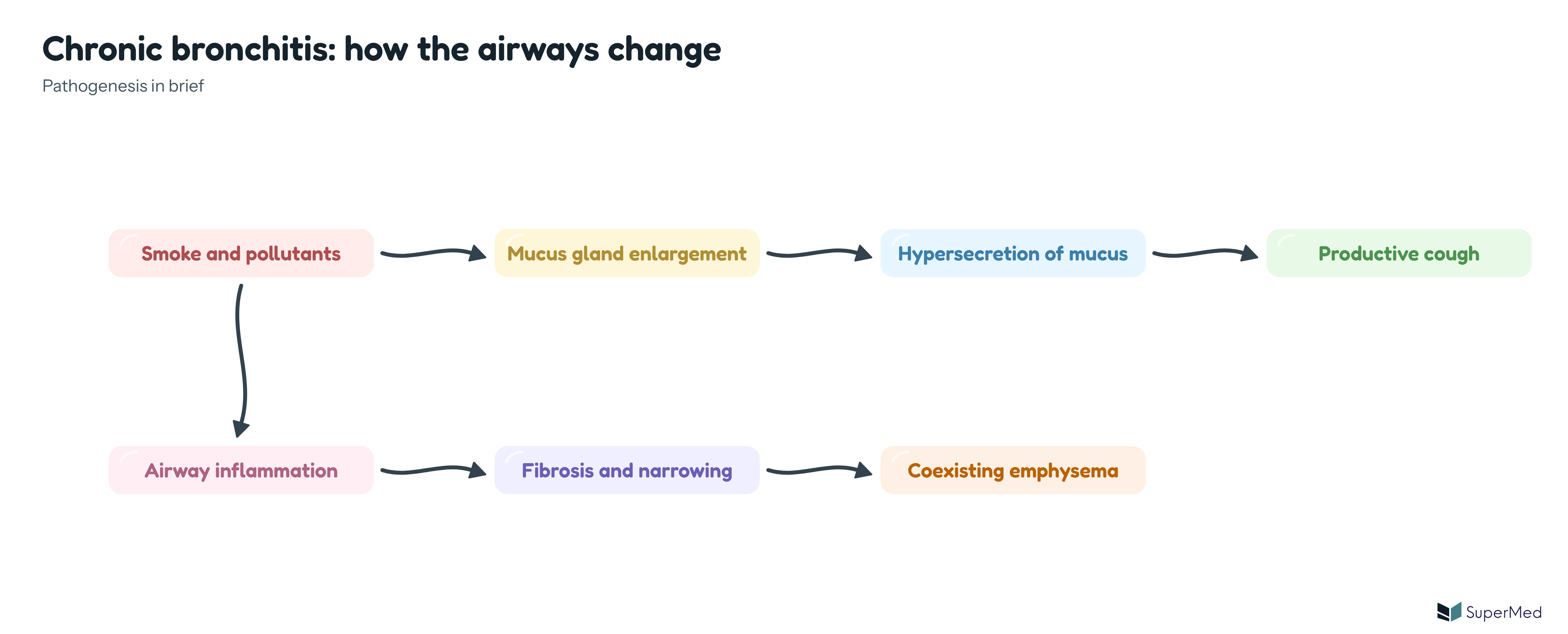
The main process is hypersecretion of mucus that starts in the large airways. Cigarette smoke and pollutants are the causative factors.

Morphological changes in the airways:

  • enlargement of the mucus-secreting glands
  • an increased number of goblet cells
  • loss of ciliated epithelial cells
  • squamous metaplasia of the airway lining
  • dysplastic changes and bronchogenic carcinoma
  • inflammation, fibrosis and narrowing of the bronchioles
  • coexisting emphysema

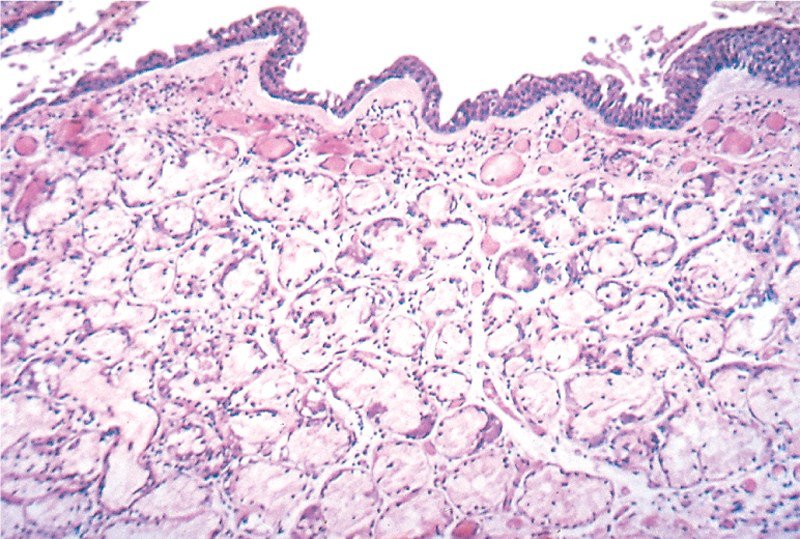
The thickness of the mucus glands is compared with the thickness of the airway wall. This is the Reid index, and a value above 0.4 is abnormal. The lecture shows this on a histology picture of the bronchial wall.

Bronchial wall in chronic bronchitis, with enlarged mucus-secreting glands beneath the lining, lecture histology slide labelled Reid Index above 0.4

Enlargement of the mucus-secreting glands and an increase in goblet cells, with an inflammatory infiltrate, raise sputum production. Loss of elastic tissue, inflammation and fibrosis in the airway wall cause premature airway closure and gas trapping.

Schematic of chronic bronchitis pathogenesis: smoke and pollutants lead along one row to mucus gland enlargement, hypersecretion of mucus and productive cough, and along a second row to airway inflammation, fibrosis and narrowing, and coexisting emphysema

Chronic bronchitis in the airway

note

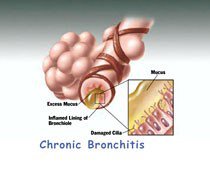
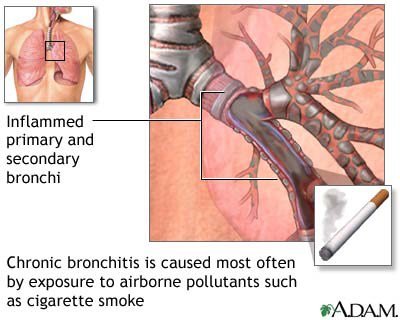
The lecture shows chronic bronchitis as enlarged mucus glands and excess mucus in the large airways, with damaged cilia, and the drawing below shows the same airway inflamed.

Drawing of chronic bronchitis: excess mucus, an inflamed bronchial lining and damaged cilia in a magnified bronchus
Drawing of inflamed primary and secondary bronchi in chronic bronchitis, with a cigarette beside it and the caption that chronic bronchitis is most often caused by airborne pollutants such as cigarette smoke

5. Clinical features

note

Symptoms

Acute bronchitis:

  • Cough, the obligatory symptom. It is dry at the start and later brings up sputum.
  • Shortness of breath in bronchiolitis, and wheezing.
  • Fever, weakness (malaise), fatigue and loss of appetite.
  • Retrosternal pain during coughing. This is a sign of tracheitis.

Chronic bronchitis:

  • Occasionally a slight cough in the morning.
  • During an exacerbation, the symptoms are the same as in acute bronchitis.
  • Prominent cough with production of sputum is the main clinical course.
  • In the later course, the disease becomes COPD with hypercapnia, hypoxaemia and cyanosis. Cardiac failure can follow.

Physical examination

FindingWhat it means
Intoxicated (toxic-looking) face when the patient has feverSystemic effect of the infection
Coarse breath sounds, or decreased vesicular breathingSecretions in the large airways, or reduced air entry
Snoring wheezes and rhonchi (coarse, rattling sounds)Secretions in the large airways
Possibly resonant rhonchiOften a sign of infection
Whistling wheezesNarrowing of the airways by bronchial spasm, as in spastic bronchitis
  • Inspection. Apart from the toxic-looking face, there are no specific inspection findings in this topic beyond the face. In later chronic bronchitis, cyanosis may be seen.
  • Palpation and percussion. There are no specific findings. The chest is usually resonant on percussion.
  • Auscultation. The findings are in the table above. In chronic bronchitis the breath sounds are typically quiet. Crackles may come with infection. If crackles persist, bronchiectasis must be considered.
  • Pulse and blood pressure. Fever usually makes the pulse faster. Blood pressure is usually normal.
  • Chronic bronchitis during an exacerbation. The examination findings are the same as in acute bronchitis.

6. Diagnosis

note

Clinical diagnosis

Acute bronchitis is diagnosed from the symptoms and the chest examination. A chest X-ray, sputum culture, blood count and sedimentation rate are used to exclude pneumonia and show signs of infection.

Chronic bronchitis is diagnosed on clinical grounds. The criterion is a persistent productive cough for at least 3 consecutive months in at least 2 consecutive years.

Laboratory tests

TestFindingPurpose
Blood countRaised white blood cell countSign of infection
Sedimentation rateRaisedSign of inflammation
C-reactive proteinRaisedSign of inflammation
Sputum cultureBacteria identifiedFinds a bacterial cause
Serological testAntibodies to a virusFinds a viral cause
Skin test for allergensPositive skin reactionsLooks for an allergic trigger, in prolonged cases and when bronchospasm is present

The blood tests are raised in infection. Blood tests can show a raised white blood cell count, sedimentation rate and C-reactive protein.

Imaging

  • Chest X-ray. It shows increased lung markings. The main use is to exclude pneumonia. It also excludes other diagnoses, such as cardiac failure, lung cancer and bullae.
  • Spirometry. In bronchiolitis, spirometry shows a restrictive pattern with reduced forced vital capacity (FVC) and reduced forced expiratory volume in 1 second (FEV1). The FEV1/FVC ratio is equal to or over 70 per cent.
  • In chronic bronchitis, airflow obstruction is confirmed by spirometry when the post-bronchodilator FEV1/FVC is below 0.7 (70 per cent). This is the standard COPD criterion.

Blood gases

  • In bronchiolitis, blood gases show hypoxaemia, often with hypercapnia.
  • Blood gases are used to evaluate the respiratory function in the most severe cases of acute bronchitis.
  • In chronic bronchitis they evaluate the respiratory function, together with spirometry.

Main diagnostic tasks

Acute bronchitis:

  • Exclude pneumonia with a chest X-ray.
  • Establish the cause: sputum culture for bacteria, or a serological test for a viral infection.
  • Evaluate respiratory function by blood gases in the most severe cases.
  • In prolonged cases, a skin test for allergy.

Chronic bronchitis:

  • Evaluate respiratory function with blood gases and spirometry.
  • When there is bronchospasm, a skin test for allergens.
  • In an exacerbation, the same as in acute bronchitis: find the cause and exclude pneumonia.
  • Establish complications, such as pulmonary emphysema or COPD, from the history, physical examination, chest X-ray and respiratory function tests.

7. Differential diagnosis

note

  • Pneumonia. It is excluded with a chest X-ray.
  • Asthma, tuberculosis, bronchiectasis and congestive cardiac failure are the main differential diagnoses of a chronic productive cough (Davidson's Principles and Practice of Medicine).
  • Haemoptysis. Acute bronchitis is one cause of blood in the sputum, alongside cancer and bronchiectasis (Davidson's Principles and Practice of Medicine).

8. Treatment

note

Acute bronchitis

  • Most cases settle with supportive care: rest, fluids, and treatment of fever and pain.
  • Antibiotics are used only when a bacterial infection is likely. The sputum culture guides this choice.
  • A bronchodilator is used when wheezing or bronchospasm is present.

Chronic bronchitis

Chronic bronchitis is treated as COPD (Davidson's Principles and Practice of Medicine):

  • Stopping smoking is the only measure that changes the natural history of the disease. It slows the fall in lung function.
  • Bronchodilators control breathlessness. A long-acting beta-agonist with a long-acting muscarinic antagonist (LABA plus LAMA) is preferred for most patients. Short-acting bronchodilators are used as relievers.
  • Inhaled corticosteroids are added in a combination inhaler for patients with frequent exacerbations or persistent breathlessness. They are most useful when eosinophils are above 300 cells per microlitre, and in patients with a history of asthma.
  • Pulmonary rehabilitation, with exercise, disease education and nutritional advice.
  • Vaccination against pneumococcus and respiratory syncytial virus, and yearly against influenza and COVID-19.
  • Mucolytic drugs and chest physiotherapy ease the expectoration of sputum.
  • Oral corticosteroids are useful during an exacerbation, but they should not be used as long-term maintenance.
  • Exacerbations are usually managed at home with more bronchodilators and a short course of oral corticosteroids. Antibiotics are added when a bacterial infection is likely.
  • Long-term oxygen improves survival in patients with severe hypoxaemia (PaO2 below 7.3 kPa, or 55 mmHg), who have also stopped smoking.

9. Complications and prognosis

note

Complications of acute bronchitis

  • Pneumonia.
  • Chronic bronchitis.

Complications of chronic bronchitis

  • Bronchiectasis.
  • Pulmonary emphysema, which is part of COPD.
  • Pneumofibrosis (fibrosis of the lung).
  • A possible predisposition to neoplasm, including bronchogenic carcinoma.
  • Hypercapnia, hypoxaemia and cyanosis in the later course, and cardiac failure.

Prognosis

  • Acute bronchitis usually recovers within a few weeks.
  • Chronic bronchitis is usually progressive when it is part of COPD. The prognosis is worse with older age and with a lower post-bronchodilator FEV1 (Davidson's Principles and Practice of Medicine).

10. Prevention

note

  • Stopping smoking and avoiding polluted air, indoor smoke and dust are the main preventive measures.
  • Patients with chronic bronchitis (COPD) should be offered vaccination against pneumococcus and respiratory syncytial virus, and yearly vaccination against influenza and COVID-19 (Davidson's Principles and Practice of Medicine).

All 81 Internal Medicine topics · exam study support, not clinical guidance. SuperMed is not affiliated with the Medical University of Sofia.

Start free. No card needed.

Every account starts free, with Medical Ethics, Urology and Computer Science open in full and free topics in Cytology, Latin Language, Medical Chemistry, Medical Physics, Medical Biology, Anatomy, Biophysics, Medical Psychology, MCS (Disaster Medicine), Physiology, Biochemistry, Social Medicine, Medical Genetics, Pharmacology, Pathophysiology, Microbiology, Internal Medicine, Nephrology, Cardiology, Pulmonology, Gastroenterology, Internal Medicine (Clinical), Obstetrics and Gynecology, Physiotherapy and Rehabilitation, Dental Materials, Preclinics of Prosthetic Dental Medicine, Medical Psychology (Dental Medicine), SMME (Social Medicine & Medical Ethics), Preclinics of Pediatric Dental Medicine, Hygiene and Epidemiology, General Surgery, Preclinics of Conservative Dental Medicine, Preclinics of Oral and Maxillofacial Medicine, Dental Public Health, Dental Prophylaxis, Diagnostic Imaging, Dental Allergology, Dental Implantology, Physiotherapy, Cytology & Histology, Medical Chemistry, Medical Physics, Anatomy I, Biophysics and Medical Biology. Super opens the rest. Super is €14.99 a month.

Create a free account