


Medical Psychology (Dental Medicine) · Year 2 · Medical University of Sofia

01

Psychology as a science - definition, subject, tasks and methods

Free notes for topic 01 of the Medical Psychology (Dental Medicine) syllabus, open without an account. Written by a senior student against the syllabus question and checked line by line by a second student before publishing. How content is made

Updated

Summary

note

Key points to hold on to:

  • Psychology is the scientific study of the psyche, human behaviour and mental processes, both normal and abnormal. It is a bridge between philosophy and the natural sciences.
  • The subject of psychology is the psyche; the object is the laws of the psyche as a specific form of human behaviour.
  • The psyche has three domains: cognitive, affective (emotions and feelings) and behavioural.
  • Psychology has three groups of tasks: fundamental, theoretical and practical (applied).
  • The main methods are testing (verbal, non-verbal, achievement-based and time-limited tests), lab experiments, case studies, interviews (structured and unstructured), questionnaires and pilot studies.

Examiner tip: if Professor Bonev (the dean) is your examiner, refer to something you have read in his book, for example "... in your book you mentioned ...".
1. Definition, subject and object of psychology

note

Definition

  • Psychology is the scientific study of the psyche, human behaviour and mental processes.
  • It examines both normal and abnormal mental functioning.
  • It acts as a bridge between philosophy and the natural sciences (for example biology, physics, anatomy).
  • It aims to explain the laws, mechanisms and regularities of human behaviour and experience.

Another way the same idea is put: psychology is the scientific study of the mind and its function and behaviour. It also covers the characteristics of the mental states and processes of a person or of groups of people, or the mental states and processes involved in a field of activity. As a science it tries to understand how and why people think, feel and act in different ways. The field is broad and includes several levels of analysis: neurological, cognitive, social and cultural approaches are all used to build an understanding of human thought and behaviour.

Subject of psychology

The subject of psychology is the psyche, the highest form of relationship between organisms (especially humans) and the world. The psyche is a property of highly organised biological matter, formed in the brain, and it is responsible for two things:

  • reflecting objective reality (through images, relationships, speech and so on);
  • managing the individual's activity and interaction with the world.

Object of psychology

The object of psychology is the laws of the psyche as a specific form of human behaviour. Put more simply, psychology studies the rules and patterns (laws) that explain how the mind influences human behaviour. These laws are studied through the cognitive, emotional, behavioural and social aspects of the person.

2. Domains of the human psyche, mental states and personality traits

note

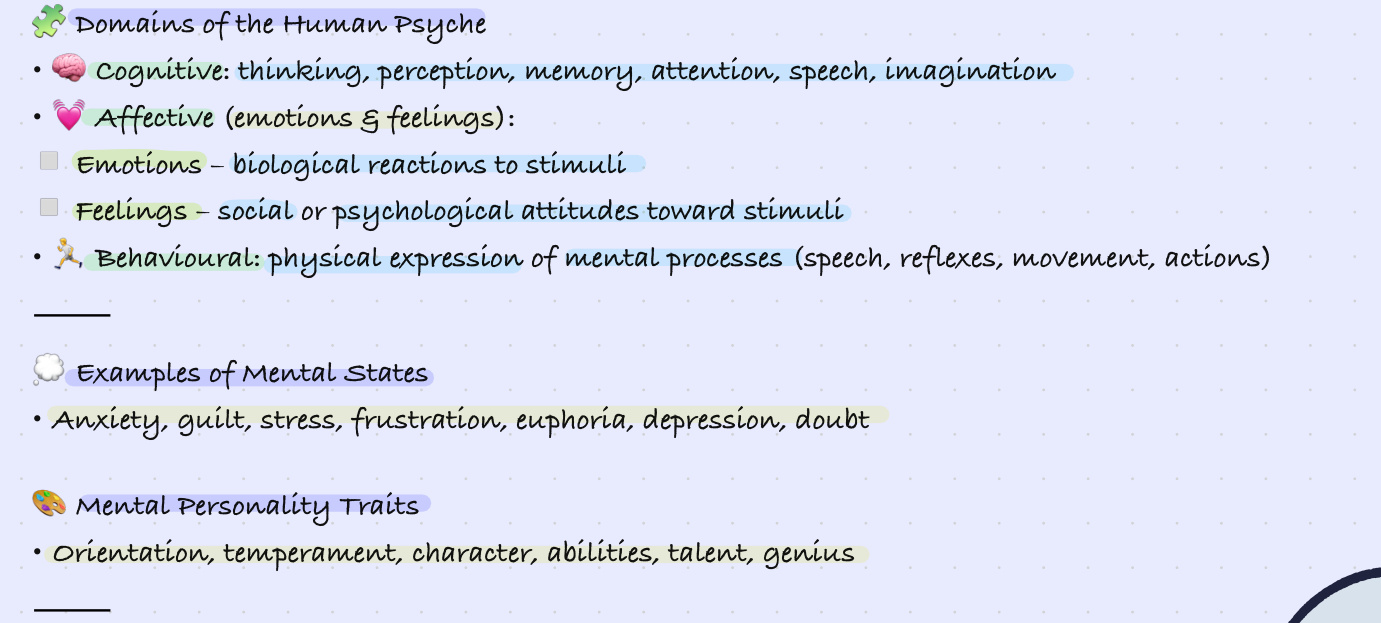
The psyche is divided into three domains:

  • Cognitive: thinking, perception, memory, attention, speech and imagination.
  • Affective (emotions and feelings). Emotions are biological reactions to stimuli; feelings are social or psychological attitudes toward stimuli.
  • Behavioural: the physical expression of mental processes (speech, reflexes, movement, actions).
Slide section Domains of the Human Psyche: cognitive (thinking, perception, memory, attention, speech, imagination), affective (emotions as biological reactions, feelings as social or psychological attitudes) and behavioural (physical expression of mental processes); with Examples of Mental States and Mental Personality Traits

Examples of mental states: anxiety, guilt, stress, frustration, euphoria, depression and doubt.

Mental personality traits: orientation, temperament, character, abilities, talent and genius.

3. Tasks of psychology

note

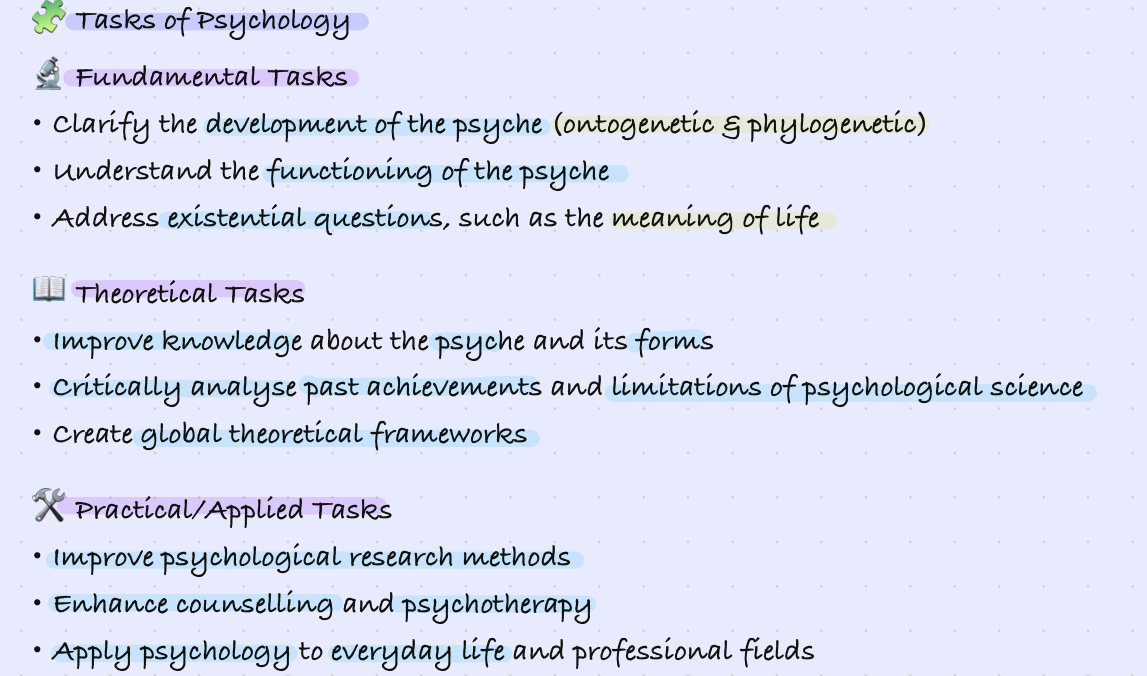
The tasks of psychology fall into three groups.

GroupTasks
Fundamental tasksClarify the development of the psyche (ontogenetic and phylogenetic); understand the functioning of the psyche; address existential questions, such as the meaning of life
Theoretical tasksImprove knowledge about the psyche and its forms; critically analyse the past achievements and limitations of psychological science; create global theoretical frameworks
Practical (applied) tasksImprove psychological research methods; enhance counselling and psychotherapy; apply psychology to everyday life and professional fields
Slide section Tasks of Psychology listing fundamental, theoretical and practical or applied tasks

4. Methods of psychological research

note

Testing

Testing is a structured, objective method of collecting data about mental functions, traits and disorders. It is commonly used in psychological assessment.

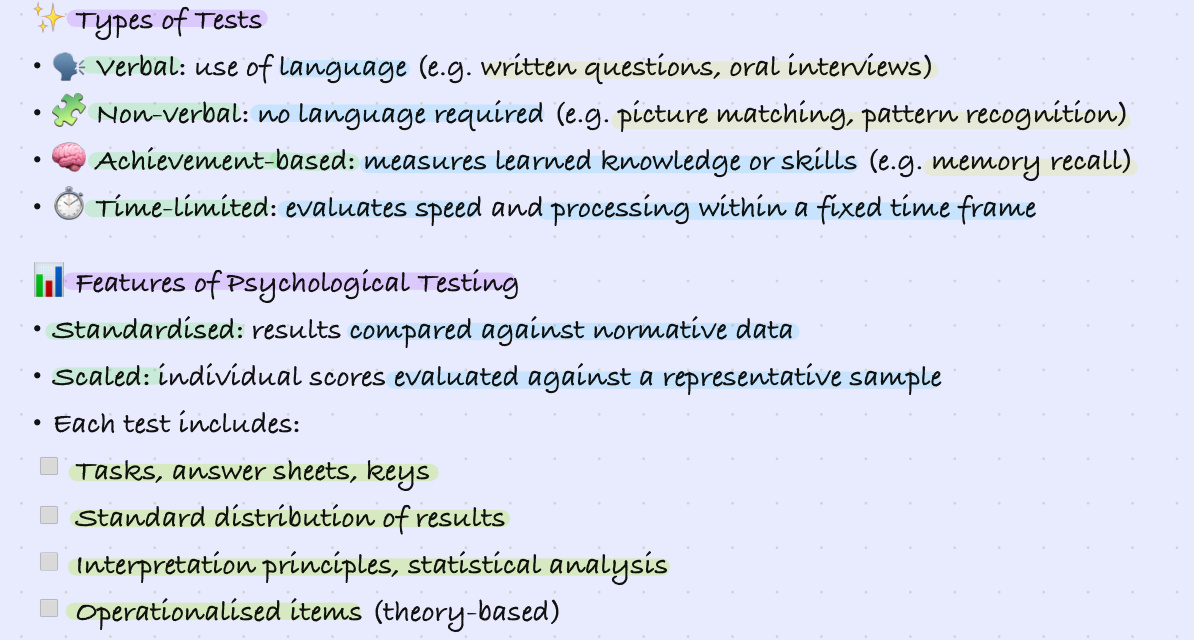
Types of tests

  • Verbaluse of language (for example written questions, oral interviews).
  • Non-verbalno language required (for example picture matching, pattern recognition).
  • Achievement-basedmeasures learned knowledge or skills (for example memory recall).
  • Time-limitedevaluates speed and processing within a fixed time frame.

Features of psychological testing

  • Standardised: results are compared against normative data.
  • Scaled: an individual's scores are evaluated against a representative sample.
  • Each test includes: tasks, answer sheets and keys; a standard distribution of results; principles of interpretation and statistical analysis; and operationalised (theory-based) items.
Slide section Types of Tests (verbal, non-verbal, achievement-based, time-limited) and Features of Psychological Testing (standardised, scaled, and what each test includes)

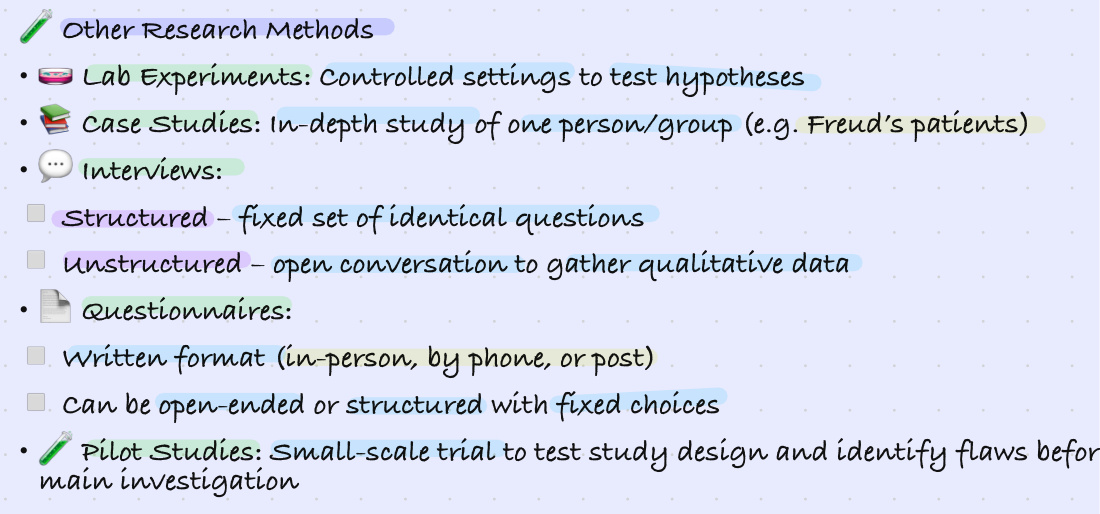
Other research methods

note

There are numerous ways of carrying out psychological studies.

Lab experiments

A lab experiment is conducted in a well-controlled environment, not necessarily a laboratory, so accurate and objective measurements are possible. Its purpose is to test hypotheses under controlled settings.

Case studies

Case studies are in-depth investigations of a single person, group, event and so on. They are widely used in psychology. Among the best known are those carried out by Sigmund Freud, who conducted very detailed investigations into the private lives of his patients in an attempt both to understand them and to help them overcome their illnesses.

Interviews

An interview can be structured or unstructured.

TypeFeatures
Unstructured (informal)Like a casual conversation. No set questions; the participant may raise whatever topics he or she feels are relevant and put them in his or her own way. Much qualitative data is likely to be collected
Structured (formal)Like a job interview. A fixed, predetermined set of identical questions is put to every participant in the same order and in the same way. The interviewer stays within the role and keeps social distance from the interviewee

Questionnaires

A questionnaire can be thought of as a kind of written interview. It can be carried out face to face, by telephone or by post. The questions can be open-ended, allowing flexibility in the respondent's answers, or more tightly structured, requiring short answers or a choice of answers from given alternatives. The choice of questions matters, because bias, ambiguity, "leading" the respondent and causing offence must be avoided.

Pilot studies

A pilot study is an initial run-through of the procedures to be used in an investigation: a few people are selected and the study is tried out on them. It is a small-scale trial to test the study design and identify flaws before the main investigation. It can save time and in some cases money, by exposing flaws in the procedures designed by the researcher. In effect it is a control test to see whether the experiment works.

Slide section Other Research Methods: lab experiments, case studies (for example Freud's patients), interviews (structured, unstructured), questionnaires (written format, open-ended or fixed choices) and pilot studies

All 27 Medical Psychology (Dental Medicine) topics · exam study support, not clinical guidance. SuperMed is not affiliated with the Medical University of Sofia.

Start free. No card needed.

Every account starts free, with Medical Ethics, Urology and Computer Science open in full and free topics in Cytology, Latin Language, Medical Chemistry, Medical Physics, Medical Biology, Anatomy, Biophysics, Medical Psychology, MCS (Disaster Medicine), Physiology, Biochemistry, Social Medicine, Medical Genetics, Pharmacology, Pathophysiology, Microbiology, Internal Medicine, Nephrology, Cardiology, Pulmonology, Gastroenterology, Internal Medicine (Clinical), Obstetrics and Gynecology, Physiotherapy and Rehabilitation, Dental Materials, Preclinics of Prosthetic Dental Medicine, Medical Psychology (Dental Medicine), SMME (Social Medicine & Medical Ethics), Preclinics of Pediatric Dental Medicine, Hygiene and Epidemiology, General Surgery, Preclinics of Conservative Dental Medicine, Preclinics of Oral and Maxillofacial Medicine, Dental Public Health, Dental Prophylaxis, Diagnostic Imaging, Dental Allergology, Dental Implantology, Physiotherapy, Cytology & Histology, Medical Chemistry, Medical Physics, Anatomy I, Biophysics and Medical Biology. Super opens the rest. Super is €14.99 a month.

Create a free account