



Physiotherapy and Rehabilitation · Year 6 · Medical University of Sofia

01

Essentials of electricity and electrotherapy

Free notes for topic 01 of the Physiotherapy and Rehabilitation syllabus, open without an account. Written by a senior student against the syllabus question and checked line by line by a second student before publishing. How content is made

Updated

Summary

note

Electricity is the movement of charged particles, and in the body current is carried mainly by ions in the body fluids. Electrotherapy uses electric current for therapeutic purposes, and the type of current decides which effect is obtained. Voltage, current and resistance are linked by Ohm's law. Tissues differ in how well they conduct, so the current does not spread evenly. The effect of a current depends on its type, strength, frequency, pulse duration, electrode size and placement, and the condition of the skin. Properly dosed, electrotherapy may relieve pain, stimulate muscle, improve circulation, reduce spasm and swelling, and support recovery after injury and immobilisation.
1. Electricity and electrotherapy

note

Electricity is the movement of electrically charged particles. In the human body, electric current is conducted mainly by ions found in the body fluids.

Electrotherapy is a method used in physiotherapy in which electric current is applied for therapeutic purposes. Depending on the type of current, it can provide pain relief, muscle stimulation, improved blood circulation and support for recovery processes.

Direct and alternating current

Current may be direct or alternating. A direct current flows in one direction only. An alternating current changes direction periodically, so it has both a positive and a negative half-wave.

Current in tissue

When current passes through tissue, positive and negative ions move. This can alter the electrical state of the cell membrane and cause excitation of nerves and muscles.

2. Basic electrical quantities

note

The following quantities describe every electrotherapy current. Their units are used in the parameter tables of each later topic.

QuantitySymbolUnitMeaning
VoltageUvolt (V)the force that causes electric charges to move
CurrentIampere (A)the amount of electric charge that passes through a point over a given period of time
ResistanceRohm (Ω)the opposition of tissues to the flow of current
Frequencyfhertz (Hz)the number of electrical pulses per second
Pulse duration-milliseconds (ms)the length of time during which one pulse acts
Intensity--the setting that determines the strength of the effect on tissues

Ohm's law

The fundamental relationship between voltage, current and resistance is U = I × R. When resistance is higher, a higher voltage is required for the same current to flow.

3. Conduction in the body

note

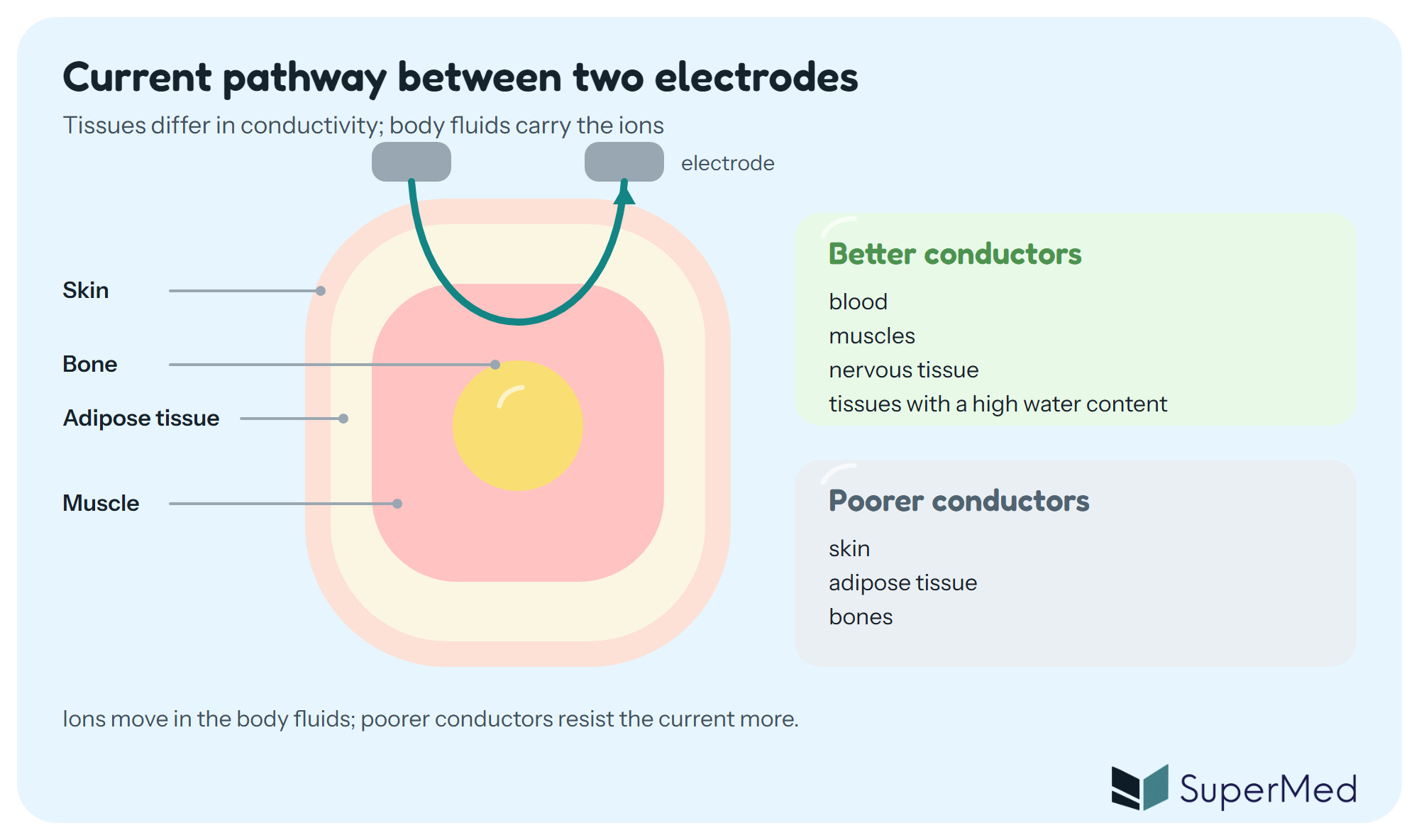
The human body conducts electricity well because it contains a large amount of water and electrolytes. Not all tissues conduct equally well.

Better conductors are:

  • blood;
  • muscles;
  • nervous tissue;
  • tissues with a high water content.

Poorer conductors are:

  • skin;
  • adipose tissue;
  • bones.
Limb cross-section with two electrodes on the skin, showing the current path through the better conducting tissues, with the better and poorer conductors listed

4. Factors that determine the effect

note

The effect of electric current on the body depends on:

  • the type of current, direct or alternating;
  • the current strength;
  • the frequency;
  • the duration;
  • the size and placement of the electrodes;
  • the condition and resistance of the skin.

Intensity sets the strength of the effect on tissues, and it is adjusted subjectively for most methods, by what the patient feels.

5. Physiological effects

note

Electric current can cause several responses in the body.

  • Nerves: it can reduce pain sensations or cause nerve excitation.
  • Muscles: it can cause muscle contraction. This is used in muscle weakness, after immobilisation and in certain neurological conditions.
  • Blood circulation: it can cause blood vessels to dilate, improving the local blood supply.
  • Metabolism: it can support tissue trophism and recovery processes.

6. Therapeutic effects

note

When properly dosed, electrotherapy may have the following therapeutic effects:

  • pain relief;
  • muscle stimulation;
  • improved blood circulation;
  • reduction of muscle spasms;
  • improved tissue trophism;
  • reduction of swelling;
  • support for recovery after injuries and immobilisation.

7. Classification of currents by frequency

note

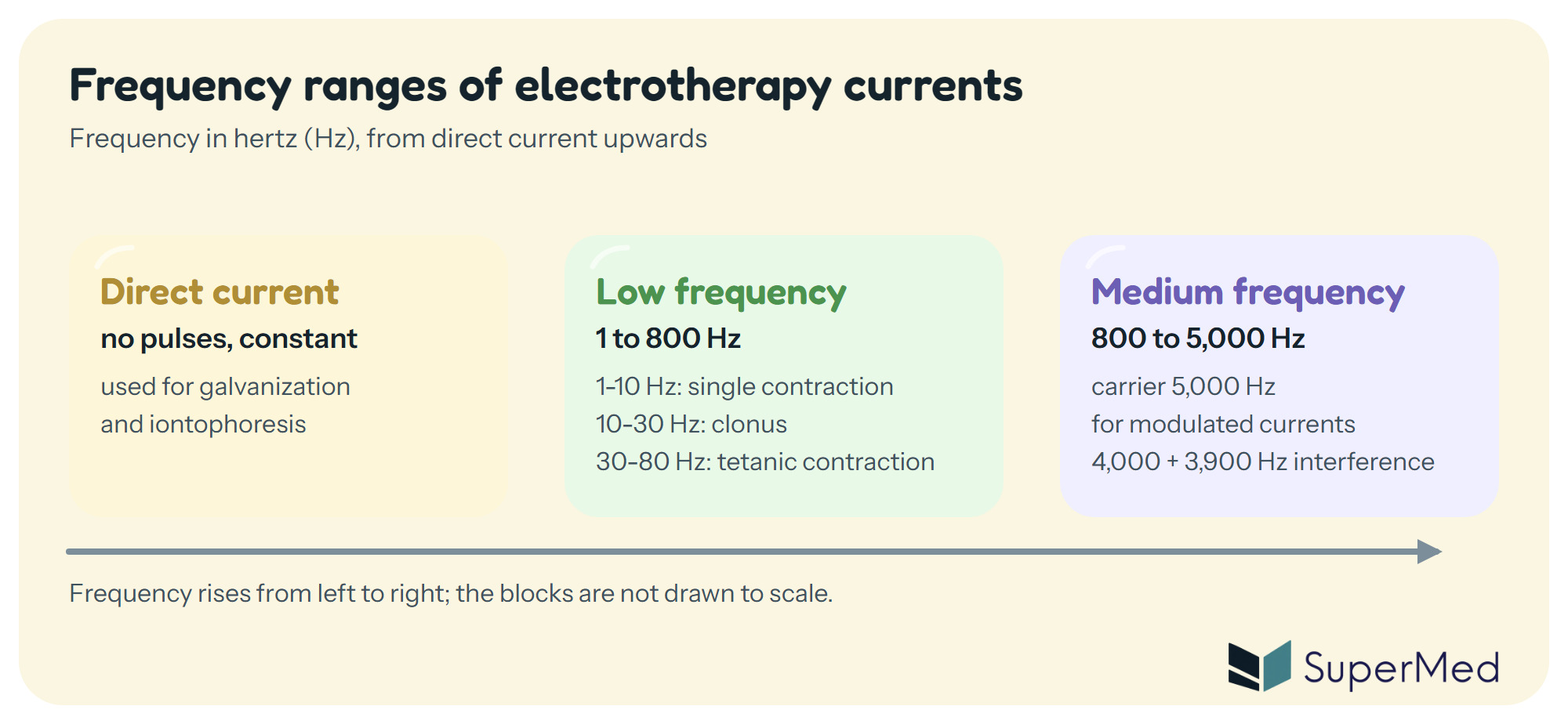
Electrotherapy currents are grouped by their frequency. The ranges below are the ones used in this topic, and each group has its own topic later in the syllabus.

  • Direct current has no pulses and is constant. It is used for galvanization and iontophoresis.
  • Low-frequency currents cover 1 to 800 Hz. Between 1 and 10 Hz they give a single contraction, between 10 and 30 Hz clonus, and between 30 and 80 Hz a tetanic contraction.
  • Medium-frequency currents cover 800 to 5,000 Hz. They use a carrier frequency of 5,000 Hz for sinusoidally modulated currents, and interference of two currents of 4,000 and 3,900 Hz.
Three blocks in order of frequency: direct current, low frequency from 1 to 800 Hz, and medium frequency from 800 to 5,000 Hz, with the contraction type at each frequency range

8. Safety, contraindications and adverse effects

note

Several contraindications recur across the galvanic and low-frequency methods. They are fever, haemorrhage, purulent processes, pregnancy, pacemakers, high blood pressure and metal implants. Anaesthesia or hypoaesthesia in the treatment area is a relative contraindication. The subjective dose is then judged by placing the electrodes on the opposite, unaffected area.

Electrode contact must be good. The skin must be clean and free of irritation before application, and electrodes must be in good condition and flat so that they make adequate contact.

Electrolysis products form under the electrodes during direct current, and hydrophilic pads must be rinsed after use to remove them.

Current density, the current per unit area of electrode, is higher under small electrodes, which raises the risk of skin burns. Prolonged or inappropriate currents can cause skin irritation or burns.

All 33 Physiotherapy and Rehabilitation topics · exam study support, not clinical guidance. SuperMed is not affiliated with the Medical University of Sofia.

Start free. No card needed.

Every account starts free, with Urology open in full and free topics in Cytology, Medical Biology, Anatomy, Biophysics, Medical Genetics, Pharmacology, Internal Medicine (Clinical), Physiotherapy and Rehabilitation, Preclinics of Prosthetic Dental Medicine, Preclinics of Pediatric Dental Medicine, Dental Prophylaxis, Diagnostic Imaging, Dental Allergology, Dental Implantology, Physiotherapy, Cytology & Histology, Anatomy I and Medical Biology. Super opens the rest. Super is €14.99 a month.

Create a free account