



Cytology · Year 1 · Medical University of Sofia

30

Cell center and centrioles

Free notes for topic 30 of the Cytology syllabus, open without an account. Written by a senior student against the syllabus question and checked line by line by a second student before publishing. How content is made

Updated

The short version

note

The centrosome, also called the cytocenter, is an amorphous region adjacent to the nucleus, so located in the centre of the cell. It is composed of 2 centrioles.

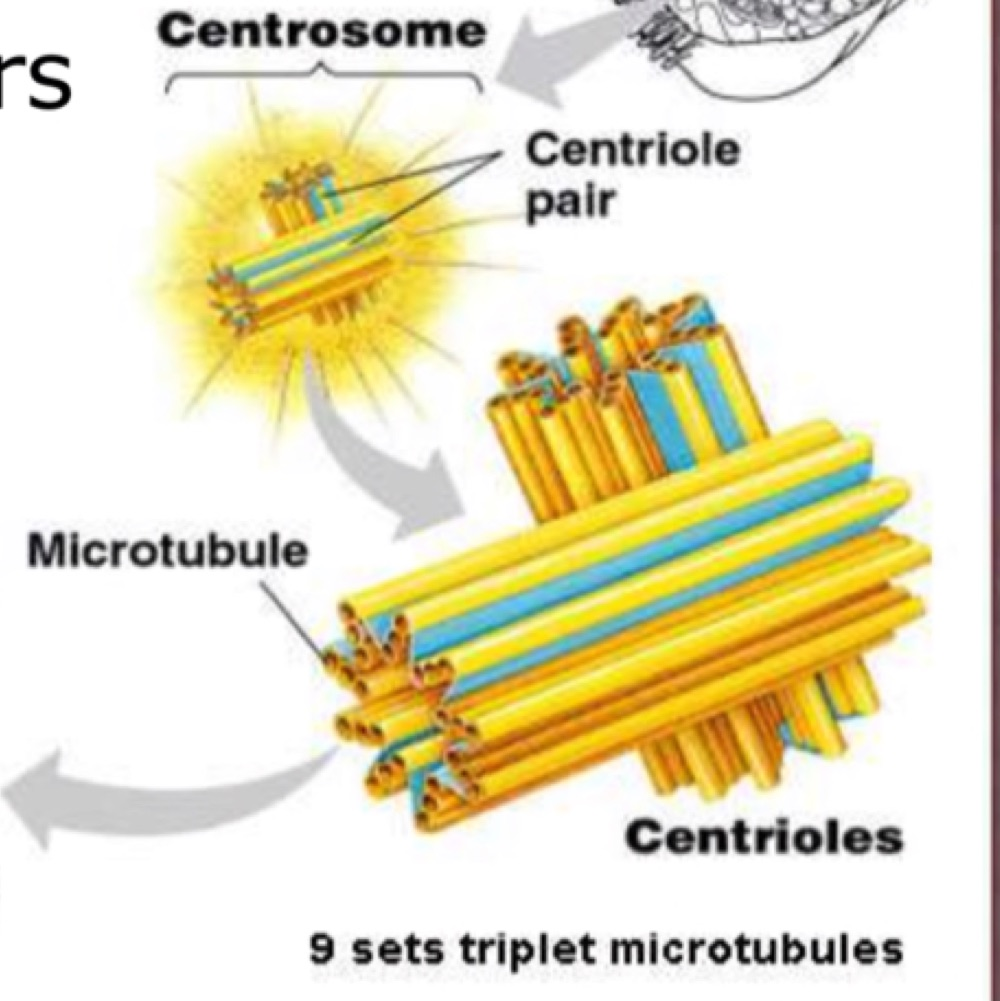
A centriole is composed of 9 microtubule triplets, that is 27 microtubules in total, with a diameter of about 0.2 μm. Centriolar satellites are non-membranous granules around the centrosome.

The centrosome is the microtubule organizing centre, the MTOC: where most microtubules are formed and their direction and orientation organised. In mitosis it forms the mitotic spindle, and it duplicates itself so that each centrosome has two pairs of centrioles.

Centrioles also form cilia, flagella and basal bodies.
1. The centrosome

note

The centrosome, also called the cytocenter, is:

  • an amorphous region adjacent to the nucleus, and so located in the centre of the cell;
  • composed of 2 centrioles.

2. Centrioles

note

A centriole is:

  • composed of 9 microtubule triplets, which is 27 microtubules in total;
  • about 0.2 μm, that is 200 nm, in diameter.

Centriolar satellites are non-membranous granules around the centrosome.

The 9 × 3 arrangement is the same one met in the basal body of a cilium, and that is not a coincidence: the basal body is a centriole doing a different job.

Diagram of the centrosome showing a centriole pair with microtubules radiating from it, and the nine sets of triplet microtubules that make up each centriole

3. The microtubule organizing centre

note

The centrosome is considered to be the microtubule organizing centre, the MTOC.

It is where most microtubules are formed and where their direction and orientation are organized.

In mitosis

note

The MTOC is important in mitosis, for the formation of the mitotic spindle.

During mitosis the MTOC, the centrosome, duplicates itself, so that each centrosome has two pairs of centrioles.

4. The centriole in the cytoskeleton

note

The centriole has a role in the generation of the cell's cytoskeleton:

  • the formation of cilia and flagella, and of basal bodies.

Basal bodies are a protein structure found in the base of cilia and flagella.

All 95 Cytology topics · exam study support, not clinical guidance. SuperMed is not affiliated with the Medical University of Sofia.

Start free. No card needed.

Every account starts free, with free topics in Cytology and Medical Biology. Super opens the rest. Super is €15 a month.

Create a free account