



Cytology · Year 1 · Medical University of Sofia

29

Cytoskeleton. Actin and intermediary filaments

Free notes for topic 29 of the Cytology syllabus, open without an account. Written by a senior student against the syllabus question and checked line by line by a second student before publishing. How content is made

Updated

The short version

note

Three filament systems, told apart by diameter.

Actin filaments, the microfilaments, are 7 nm, the thinnest filaments: highly dynamic, very thin, double-stranded, located close to the plasma membrane in the cell cortex. They are linear F-actin polymers of G-actin monomers, and they grow by addition at the (+) or barbed end and shrink at the (−) or pointed end, a balance known as treadmilling.

Intermediate filaments are 8 to 10 nm, between microfilaments and microtubules in size, and they are stable. They come in 6 types: keratin, vimentin, desmin, GFAP, neurofilament and lamins.

Thick myosin filaments are 15 nm.
1. Actin filaments

note

Actin filaments, also called microfilaments, are a highly dynamic, very thin, double-stranded structure.

  • Their diameter is 7 nm, making them the thinnest filaments.
  • They are abundantly located close to the plasma membrane, at the periphery, in the cell cortex.
  • Their structure is linear F-actin polymers of G-actin monomers.
  • They are shorter but more flexible than microtubules.

Treadmilling

note

Actin filaments show dynamic instability, as microtubules do, but the ends have their own names.

  • Addition of G-actin subunits happens at the (+), or barbed, end.
  • Removal happens at the (−), or pointed, end.
  • The balance of polymerization and depolymerization is known as treadmilling.

The image the word gives is exact: subunits are added at one end and lost at the other at the same rate, so the filament stays the same length while material moves through it.

Functions of actin filaments

note

  • Transport of organelles, vesicles and granules, in the process of cytoplasmic streaming.
  • Maintaining cell structure.
  • Muscle contraction: they generate forces on the filaments to support contraction.
  • Rapid assembly and disassembly of filaments facilitate cell migration.

2. Intermediate filaments

note

Intermediate filaments consist of different proteins in different cell types, which are strung together to polymers.

  • Their diameter is 8 to 10 nm, in size between microfilaments and microtubules. That is where the name comes from.
  • They are stable, unlike the other two systems, which are dynamic.

The six types

note

They are subcategorised into 6 types by amino acid sequence:

TypeWhere
KeratinIn all epithelial cells
VimentinIn mesenchymal cells, that is stem cells in bone marrow
DesminIn muscle cells
GFAP, glial fibrillar acidic proteinSupporting cells for astrocytes
NeurofilamentIn neurons
LaminsThe nuclear lamina

The list is worth learning as a map of tissue types: name the tissue and the filament follows. Lamins are the exception, being defined by location inside the nucleus rather than by a tissue.

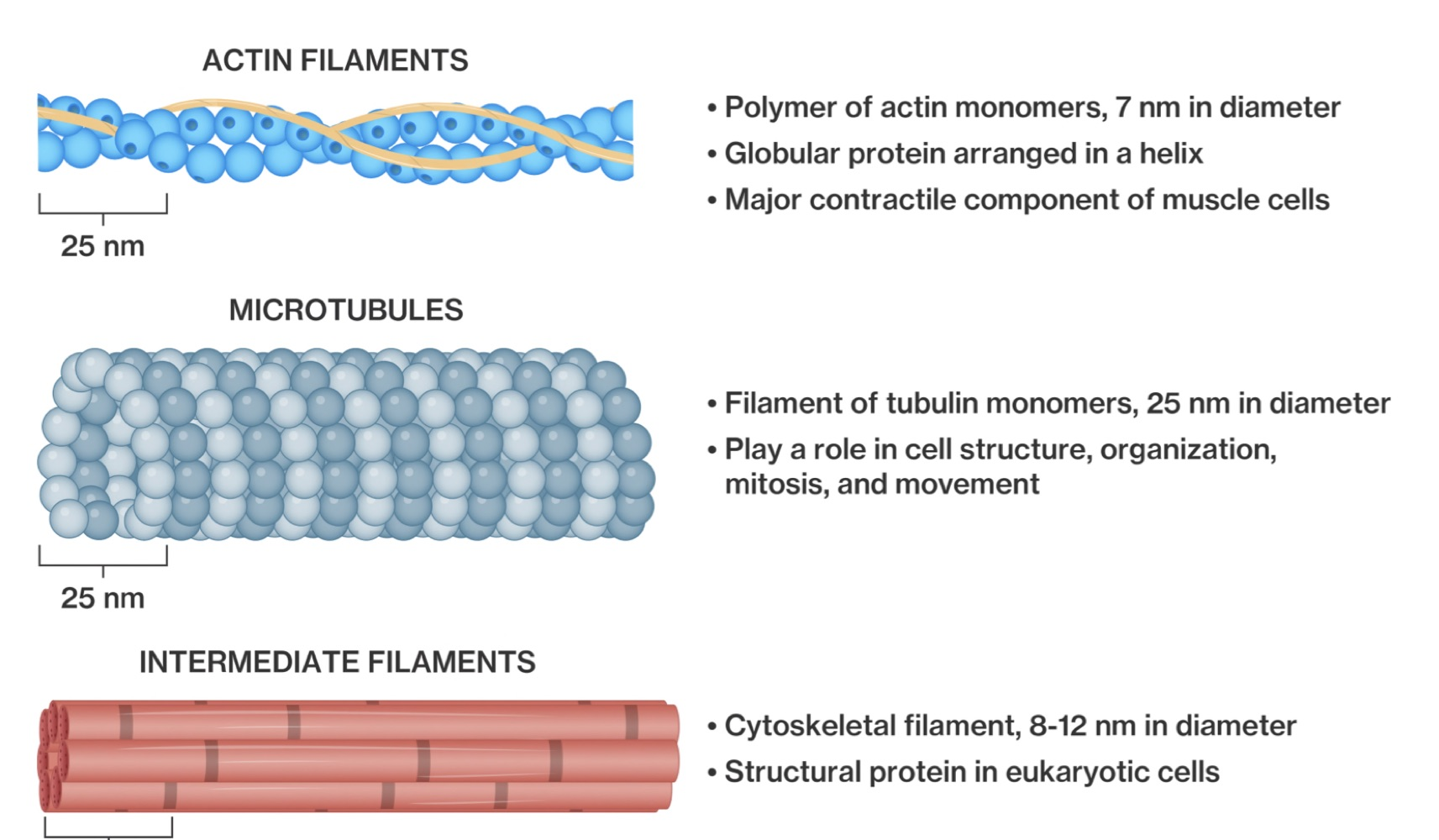
Comparison of actin filaments, microtubules and intermediate filaments drawn to scale, with a note of each one's diameter, composition and role

The figure on this page gives the diameter of intermediate filaments as 8 to 12 nm, where the text gives 8 to 10 nm. Both ranges are in use; what matters is that intermediate filaments sit between the 7 nm actin filaments and the 25 nm microtubules, which is what the name records.

3. Myosin filaments

note

Thick myosin filaments have a diameter of 15 nm.

  • Heavy meromyosin, the heavy chain, is the head plus the proximal 60 nm of the tail.
  • Light meromyosin, the light chain, is the distal 90 nm of the tail.
  • One filament is made of 2 heavy chains and 2 pairs of light chain.

All 95 Cytology topics · exam study support, not clinical guidance. SuperMed is not affiliated with the Medical University of Sofia.

Start free. No card needed.

Every account starts free, with free topics in Cytology and Medical Biology. Super opens the rest. Super is €15 a month.

Create a free account