



Cytology · Year 1 · Medical University of Sofia

28

Cytoskeleton. Microtubules

Free notes for topic 28 of the Cytology syllabus, open without an account. Written by a senior student against the syllabus question and checked line by line by a second student before publishing. How content is made

Updated

The short version

note

The cytoskeleton is a complex running from the cell nucleus to the plasma membrane, and it consists of microtubules, microfilaments, also called actin filaments, and intermediate filaments.

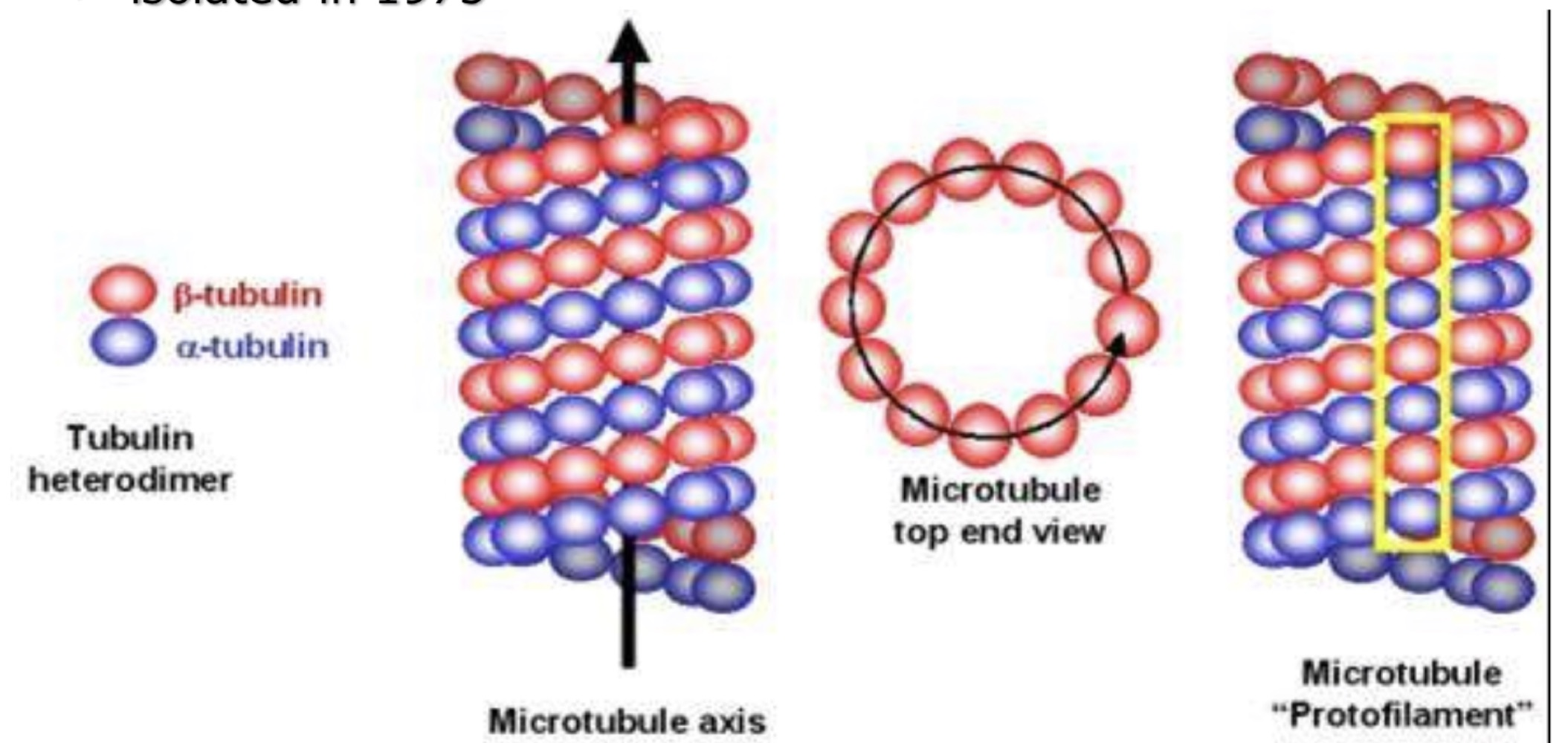
Microtubules are highly dynamic, fine tubular structures, hollow, of 25 nm diameter, arranged as a ring of 13 protofilaments whose main component is α- and β-tubulin.

They have two ends. The positive end is fast-growing, growing by the addition of tubulin dimers, a process called polymerization. The negative end is slow-growing, shrinking by the removal of tubulin dimers, called depolymerization. Combining both, with rapid transition between them, is dynamic instability, and it is what makes microtubules fast.
1. The cytoskeleton

note

The cytoskeleton is a complex from the cell nucleus to the plasma membrane.

It consists of:

  • microtubules;
  • microfilaments, also called actin filaments;
  • intermediate filaments.

Its functions are:

  • to provide structural support to the cell and stabilise junctions between cells;
  • movement of organelles and materials throughout the cell;
  • movement of the entire cell.

2. Microtubules

note

Microtubules are highly dynamic and fine tubular structures.

Their structure:

  • Each microtubule is hollow, with a diameter of 25 nm.
  • They vary in length, but can become many micrometres long. Sometimes two or more are linked side by side, which is important in axonemes, that is in cilia and flagella.
  • They are arranged as a ring of 13 protofilaments.
  • Their main component is α- and β-tubulin.
Diagram of a microtubule showing alpha and beta tubulin forming a heterodimer, the microtubule seen from the top and in cross-section, and a single protofilament along the microtubule axis

Elongation: the two ends

note

A microtubule is not symmetrical, and the two ends behave differently.

The positive (+) end is the fast-growing end. It grows rapidly via the addition of tubulin dimers, in a process called polymerization.

The negative (−) end is the slow-growing end. It shrinks via the removal of tubulin dimers, in a process called depolymerization.

Dynamic instability

note

Microtubules show dynamic instability: a combination of growth, shrinkage and rapid transition between these two, that is between polymerization and depolymerization.

It is useful for speed. A structure that can dismantle itself at one end while building at the other can be relocated far faster than one that must be built and unbuilt in place.

3. Key functions of microtubules

note

  • Development and maintenance of cell shape and polarity.
  • Intracellular transport of organelles.
  • Formation of the mitotic spindle during mitosis, for the movement of chromosomes.
  • Movement and formation of cilia and flagella, centrioles and basal bodies.

All 95 Cytology topics · exam study support, not clinical guidance. SuperMed is not affiliated with the Medical University of Sofia.

Start free. No card needed.

Every account starts free, with free topics in Cytology and Medical Biology. Super opens the rest. Super is €15 a month.

Create a free account