



Cytology · Year 1 · Medical University of Sofia

27

Protein synthesis. Proteasomes

Free notes for topic 27 of the Cytology syllabus, open without an account. Written by a senior student against the syllabus question and checked line by line by a second student before publishing. How content is made

Updated

The short version

note

Protein synthesis happens in two stages. Transcription turns DNA into RNA, in the cell nucleus: the sequence of DNA is transcribed into a complementary strand of mRNA. Translation turns RNA into protein, in the cytoplasm: the genetic code in mRNA is read to make a protein.

Translation has three steps: initiation, where the mRNA attaches to a ribosome and the start codon AUG is read; elongation, where the ribosome slides codon by codon and each amino acid is linked by peptide bonds; and termination, when a stop codon, UAA, UAG or UGA, is reached.

Proteasomes are the opposite process. They are small, abundant protein complexes with a cylindrical structure of 4 stacked rings, each of 7 proteins, and they carry out protein quality control by degrading damaged or misfolded proteins.
1. The two stages

note

Protein synthesis has two stages.

Transcription: DNA to RNA, occurring in the cell nucleus. The sequence of DNA is transcribed into a complementary strand of mRNA.

Translation: RNA to protein, occurring in the cytoplasm. The genetic code in mRNA is read to make a protein.

The division is also a division of place. Transcription happens where the DNA is and cannot leave; translation happens where the ribosomes are. The mRNA is what crosses between them.

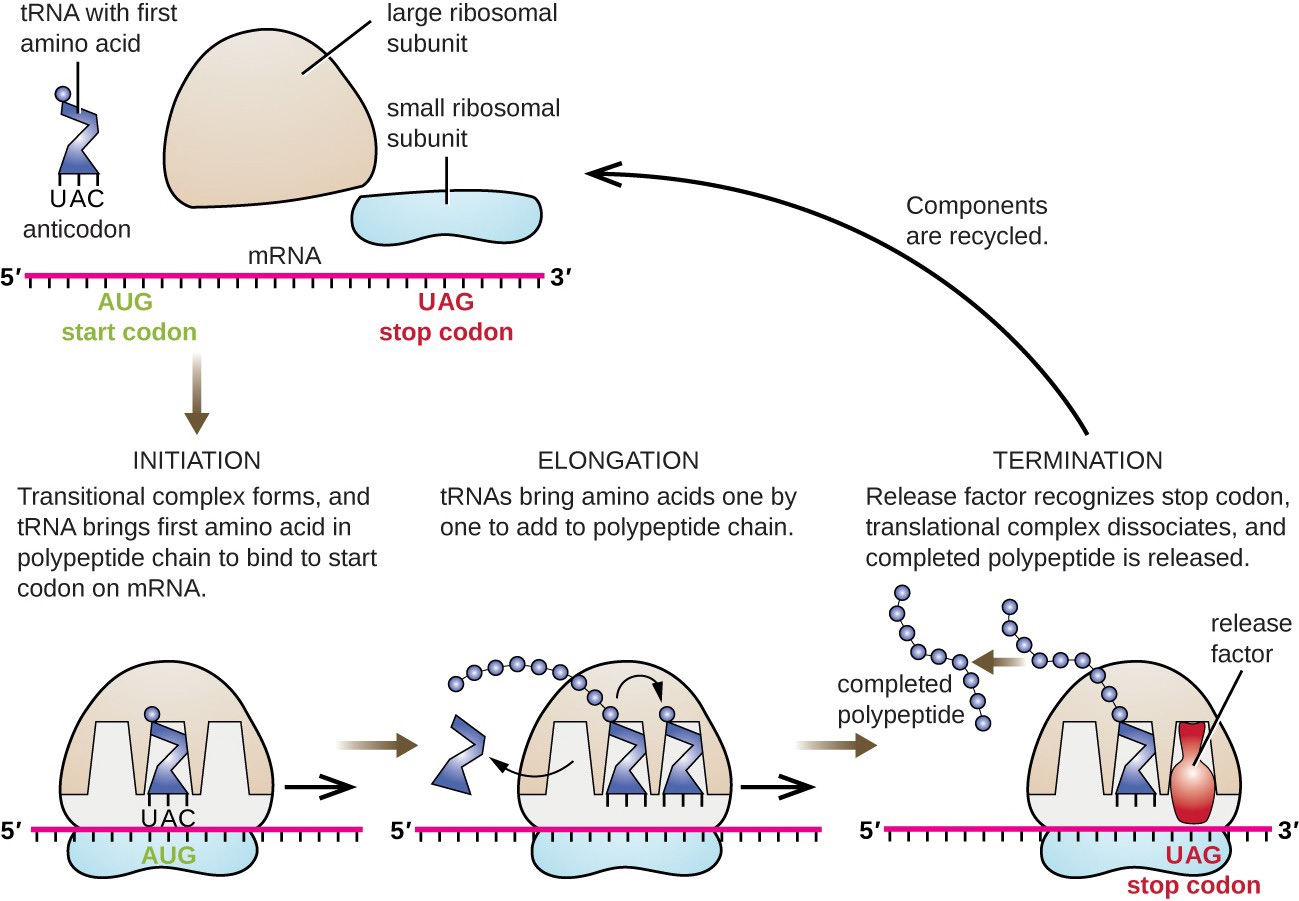
Diagram of protein synthesis showing the ribosomal subunits, the mRNA with its start and stop codons, and tRNA delivering amino acids during initiation, elongation and termination

2. Translation, step 1: initiation

note

  • mRNA leaves the nucleus and attaches to ribosomes, where the first codon is read.
  • The start codon is AUG.
  • The small ribosomal subunit binds to the start of the mRNA sequence.
  • tRNA decodes the specific codon of mRNA using its anticodon, and transfers an amino acid to the end of the growing peptide chain on the large ribosomal subunit.

The division of labour is the same one met in the ribosome topic: the small subunit reads, the large subunit builds.

3. Translation, step 2: elongation

note

  • The ribosome slides to the next codon and continues translation, until all codons are read.
  • Each corresponding amino acid is added to the growing chain, linked via peptide bonds.

4. Translation, step 3: termination

note

  • Termination occurs when the ribosome reaches a stop codon.
  • The stop codons are UAA, UAG and UGA.
  • Translation is complete and the new protein is released.

5. Proteasomes

note

Proteasomes are small, abundant protein complexes.

Their structure is cylindrical: 4 stacked rings, each composed of 7 proteins.

Function of the proteasome

note

The proteasome works in protein quality control.

  • It degrades damaged or misfolded proteins by breaking down the peptide bonds, a process called proteolysis, helped by proteases.
  • The peptides are degraded into amino acids, which can be reused for synthesising new proteins.

So the two halves of this topic run in opposite directions and meet: the ribosome makes peptide bonds, the proteasome breaks them, and the amino acids go round again.

All 95 Cytology topics · exam study support, not clinical guidance. SuperMed is not affiliated with the Medical University of Sofia.

Start free. No card needed.

Every account starts free, with free topics in Cytology and Medical Biology. Super opens the rest. Super is €15 a month.

Create a free account