



Cytology · Year 1 · Medical University of Sofia

26

Structure and replication of DNA

Free notes for topic 26 of the Cytology syllabus, open without an account. Written by a senior student against the syllabus question and checked line by line by a second student before publishing. How content is made

Updated

The short version

note

DNA is the nucleic acid that contains the genetic information. It is arranged as a double helix whose two strands are antiparallel, meaning oppositely orientated.

The sides of the structure are composed of nucleotides: a phosphate group, deoxyribose and a nucleobase. The rungs are hydrogen bonds between the bases: 2 between A and T, 3 between G and C.

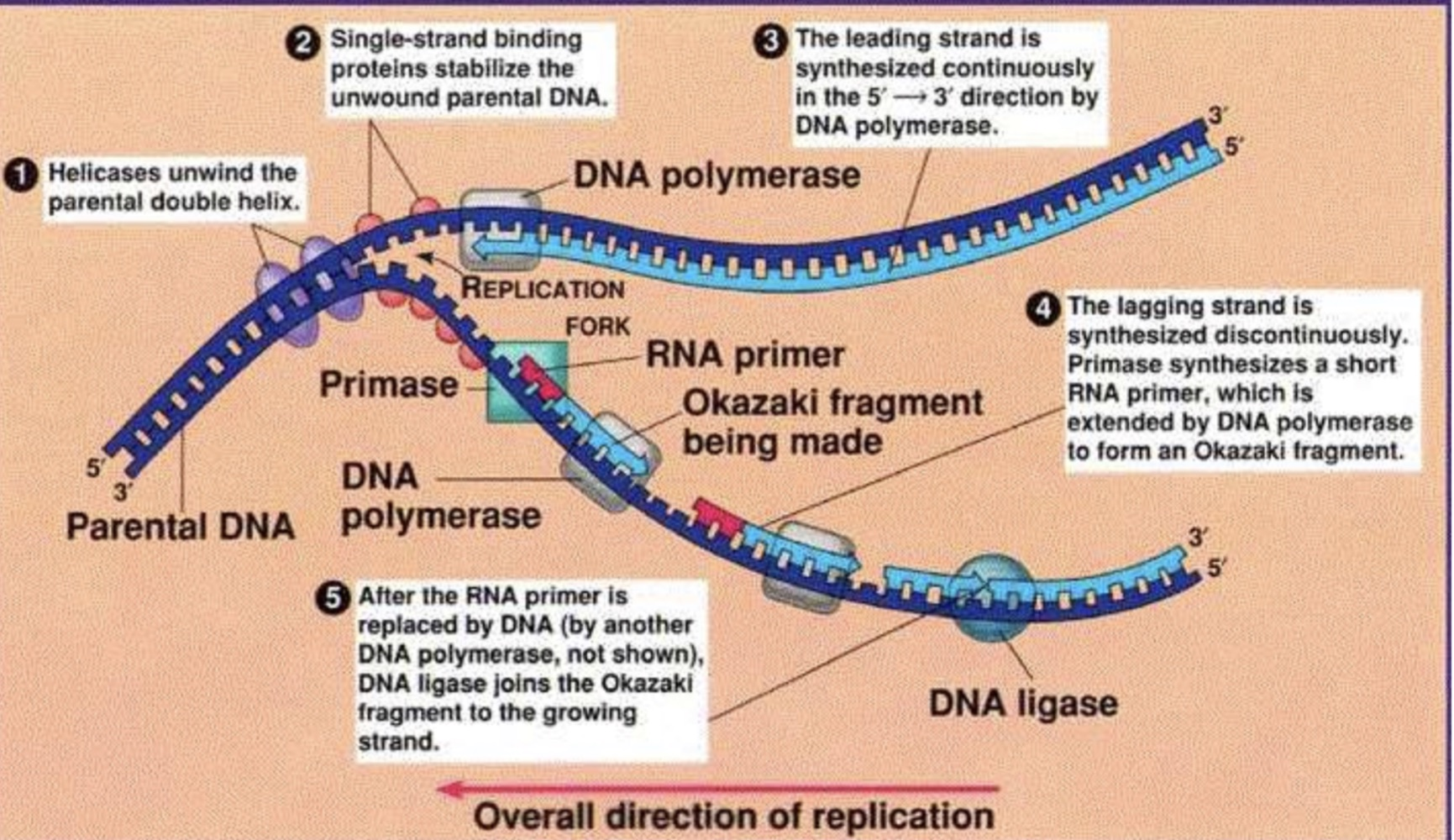
Replication is the process by which DNA makes a copy of itself during cell division. Helicases unwind the helix and create the replication fork; single-strand binding proteins stop it snapping back; the leading strand is synthesised continuously 5' to 3' by DNA polymerase; the lagging strand is synthesised discontinuously as Okazaki fragments, primed by primase and finally joined by DNA ligase.
1. Structure of DNA

note

DNA is the nucleic acid that contains the genetic information.

  • DNA is arranged in the form of a double helix.
  • DNA strands are antiparallel, meaning they are oppositely orientated.

The sides and the rungs

note

Think of the double helix as a ladder.

The sides of the structure are composed of nucleotides, each of which is:

  • a phosphate group;
  • deoxyribose;
  • a nucleobase.

The rungs are hydrogen bonds between the bases:

  • 2 hydrogen bonds between A and T;
  • 3 hydrogen bonds between G and C.

The nucleobases divide into two families:

  • purines: adenine and guanine;
  • pyrimidines: thymine and cytosine.

The 2 and the 3 are worth holding on to: G and C are held together more strongly than A and T, which is why a region rich in G and C is harder to separate.

2. DNA replication

note

DNA replication is the process by which DNA makes a copy of itself during cell division.

It runs in five steps.

Step 1. Unwinding

note

Helicases unwind the double helix, which exposes two single strands and creates the replication fork.

Step 2. Holding it open

note

Single-strand binding proteins stabilise the unwound DNA and prevent the fork from snapping back together.

The strands were held together by hydrogen bonds and would re-form them the moment the helicase passed. Something has to keep them apart while the copying happens.

Step 3. The leading strand

note

The leading strand is synthesised continuously in the 5' to 3' direction by DNA polymerase.

Step 4. The lagging strand

note

The lagging strand runs in the opposite direction and is synthesised discontinuously.

  • Primase synthesises a short RNA primer, which is extended by DNA polymerase III to form Okazaki fragments.
  • Okazaki fragments are the building block for DNA synthesis of the lagging strand.

The whole complication of the lagging strand exists because DNA polymerase can only work in one direction, and the two strands run opposite ways. One strand gets copied smoothly; the other has to be copied backwards in short pieces.

Step 5. Finishing

note

After the RNA primer is replaced by DNA polymerase, it can fill the left gaps.

Finally, DNA ligase joins the Okazaki fragments to the growing strand.

Diagram of a replication fork showing helicase unwinding the parental double helix, single-strand binding proteins, primase laying an RNA primer, DNA polymerase synthesising the leading strand continuously and the lagging strand as Okazaki fragments, and DNA ligase joining them

All 95 Cytology topics · exam study support, not clinical guidance. SuperMed is not affiliated with the Medical University of Sofia.

Start free. No card needed.

Every account starts free, with free topics in Cytology and Medical Biology. Super opens the rest. Super is €15 a month.

Create a free account