



Cytology · Year 1 · Medical University of Sofia

08

Cell culture. Principles and application

Free notes for topic 08 of the Cytology syllabus, open without an account. Written by a senior student against the syllabus question and checked line by line by a second student before publishing. How content is made

Updated

The short version

note

Cell culture is the process by which cells are grown under controlled conditions, outside their natural environment.

The sequence to remember is: cells are removed from a tissue, placed in a dish as a primary cell culture, proliferate until they reach confluence and stop, are subcultured into a fresh vessel to make a cell line, and, if certain changes occur, become immortal by a process called transformation.

It is used for the development of new drugs, vaccine creation, cytogenetic research, and the study of metabolism in normal and cancerous cells.
1. What cell culture is

note

Cell culture is the process by which cells are grown under controlled conditions, that is, outside their natural environment.

These conditions vary for each cell type, but generally they consist of a medium with the essential nutrients: amino acids, carbohydrates, vitamins and so on.

2. The process of cell growth in favourable conditions

note

The steps are:

  • Cells are removed from the tissue, mechanically or enzymatically.
  • They are placed in a clear dish with sterile procedures. This is called the primary cell culture.
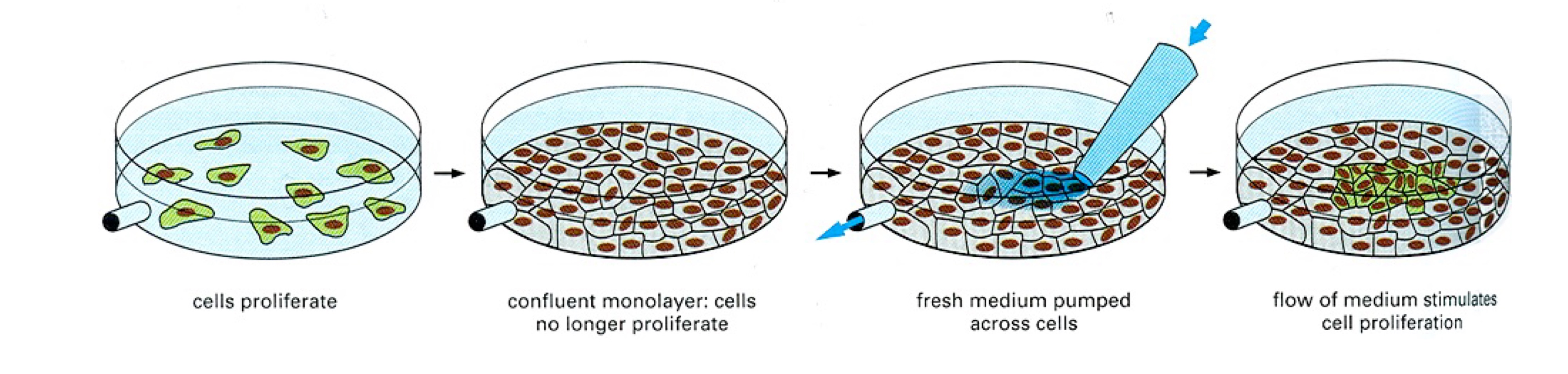
  • They proliferate until they have depleted all the available substrate. At that point they have reached confluence and no longer proliferate.
  • The cells now have to be subcultured, by transferring them into a new vessel with fresh growth medium, which stimulates cell proliferation. They then constitute a permanent cell line.
  • Most cells have a limited life span. Certain changes can promote cell immortality, and this is called transformation.
Four dishes in sequence showing cells proliferating, a confluent monolayer in which cells no longer proliferate, fresh medium being pumped across the cells, and the flow of medium stimulating cell proliferation

Confluence, and why subculture is needed

note

Confluence is not the cells becoming tired. It is the substrate running out and the dish running out of room. The cells have covered the available surface and consumed what was in the medium, and both of those are reasons to stop dividing.

Subculturing solves both at once: a new vessel gives space, and fresh medium gives nutrients. That is why the same cells that had stopped begin proliferating again as soon as they are moved.

3. Applications

note

Cell culture is used for:

  • the development of new drugs;
  • vaccine creation;
  • cytogenetic research;
  • the study of metabolism of normal and cancerous cells.

All 95 Cytology topics · exam study support, not clinical guidance. SuperMed is not affiliated with the Medical University of Sofia.

Start free. No card needed.

Every account starts free, with free topics in Cytology and Medical Biology. Super opens the rest. Super is €15 a month.

Create a free account