



Cytology · Year 1 · Medical University of Sofia

37

Cell death: necrosis and apoptosis

Free notes for topic 37 of the Cytology syllabus, open without an account. Written by a senior student against the syllabus question and checked line by line by a second student before publishing. How content is made

Updated

The short version

note

All living cells become old and die. Death is classified two ways: apoptosis is regulated cell death, and necrosis is accidental cell death due to injury.

Necrosis is caused by external factors such as infection, toxins, trauma and injury. Its cellular changes run in a sequence: karyopyknosis, shrinkage of the nucleus with chromatin condensing; karyorrhexis, fragmentation of the nucleus; karyolysis, complete dissolution of chromatin due to loss of DNA.

Apoptosis is the regulated process by which unneeded and defective cells are eliminated, and it is usually beneficial: cancerous and virus-infected cells get eliminated, and the balance of cells in the body is maintained.

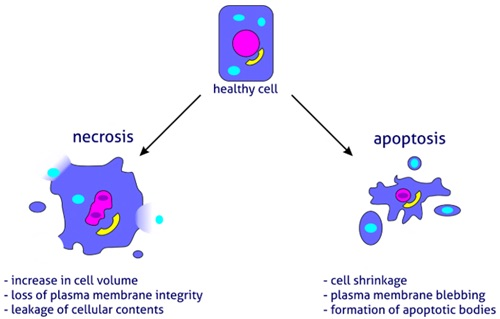
The single best discriminator is volume. A necrotic cell swells and its membrane is damaged; an apoptotic cell shrinks and its membrane blebs but stays intact.
1. The two classifications

note

All living cells become old and die.

  • Regulated cell death is apoptosis.
  • Accidental cell death due to injury is necrosis.

2. Necrosis

note

Necrosis is cell death caused by external factors, such as infection, toxins, trauma and injury.

Cellular changes in necrosis

note

Three changes, and they are a sequence rather than a list. Each is a further stage of the same nucleus falling apart.

ChangeWhat happens
KaryopyknosisShrinkage of the nucleus, chromatin condenses
KaryorrhexisFragmentation of the nucleus, dispersal completes
KaryolysisComplete dissolution of chromatin in the nucleus, due to loss of DNA

The three names share the stem karyo-, meaning nucleus, and differ only in what is done to it: shrunk, broken, dissolved.

3. Apoptosis

note

Apoptosis is the regulated process by which unneeded and defective cells are eliminated.

It is usually a beneficial process:

  • cancerous and virus-infected cells get eliminated;
  • it maintains the balance of cells in the human body.

Features of apoptosis

note

  • Loss of mitochondrial function and caspase activation, leading to degradation of proteins. Caspase activation is a process that ensures the cellular components are degraded.
  • Fragmentation of DNA.
  • Shrinkage of nuclear and cell volume, by destruction of cytoskeleton and chromatin.
  • The plasma membrane undergoes shape changes, called blebbing.

4. Necrosis and apoptosis compared

note

This is the table to be able to reproduce under questioning.

Feature of dying cellsNecrosisApoptosis
Cell swelling+++−
Cell shrinkage−+++
Damage to the plasma membrane+++−
Plasma membrane blebbing−+++
Aggregation of chromatin−+++
Fragmentation of the nucleus−+++
Oligonucleosomal DNA fragmentation−+++
Random DNA degradation+−
Caspase cascade activation−+++

Two rows carry most of the discrimination. Swelling against shrinkage, and damage to the membrane against blebbing of an intact one. A necrotic cell bursts and spills its contents, which is why necrosis provokes inflammation; an apoptotic cell packages itself up, which is why apoptosis does not.

Diagram of a healthy cell with arrows to necrosis, showing increase in cell volume, loss of plasma membrane integrity and leakage of cellular contents, and to apoptosis, showing cell shrinkage, plasma membrane blebbing and formation of apoptotic bodies

All 95 Cytology topics · exam study support, not clinical guidance. SuperMed is not affiliated with the Medical University of Sofia.

Start free. No card needed.

Every account starts free, with free topics in Cytology and Medical Biology. Super opens the rest. Super is €15 a month.

Create a free account