


Cytology · Year 1 · Medical University of Sofia

15

Membrane transport. Passive and active transport

Free notes for topic 15 of the Cytology syllabus, open without an account. Written by a senior student against the syllabus question and checked line by line by a second student before publishing. How content is made

Updated

The short version

note

Membrane transport is the exchange of materials between the cell and its environment through the plasma membrane, and it divides on one question: does it cost energy?

Passive transport does not require energy. It comes in three forms: simple diffusion for small, non-polar, hydrophobic molecules straight through the lipid bilayer; facilitated diffusion for ions and small polar molecules, assisted by a transport protein; and osmosis, the diffusion of water across a selectively permeable membrane.

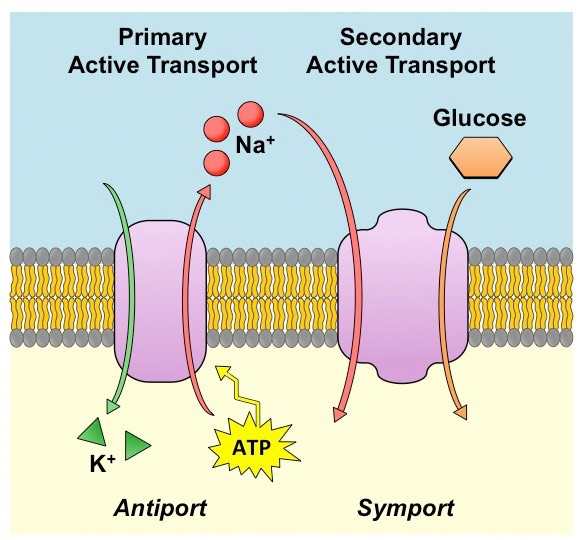
Active transport moves small molecules and ions against their concentration gradient by transmembrane protein pumps. Primary active transport is powered directly by ATP; secondary active transport, or cotransport, harnesses the movement of a second substance down its own gradient instead.

Everything passive moves down a gradient. Everything active moves up one. That is the whole distinction.
1. What membrane transport is

note

Membrane transport is the exchange of materials between the cell and its environment, through the plasma membrane.

2. Passive transport

note

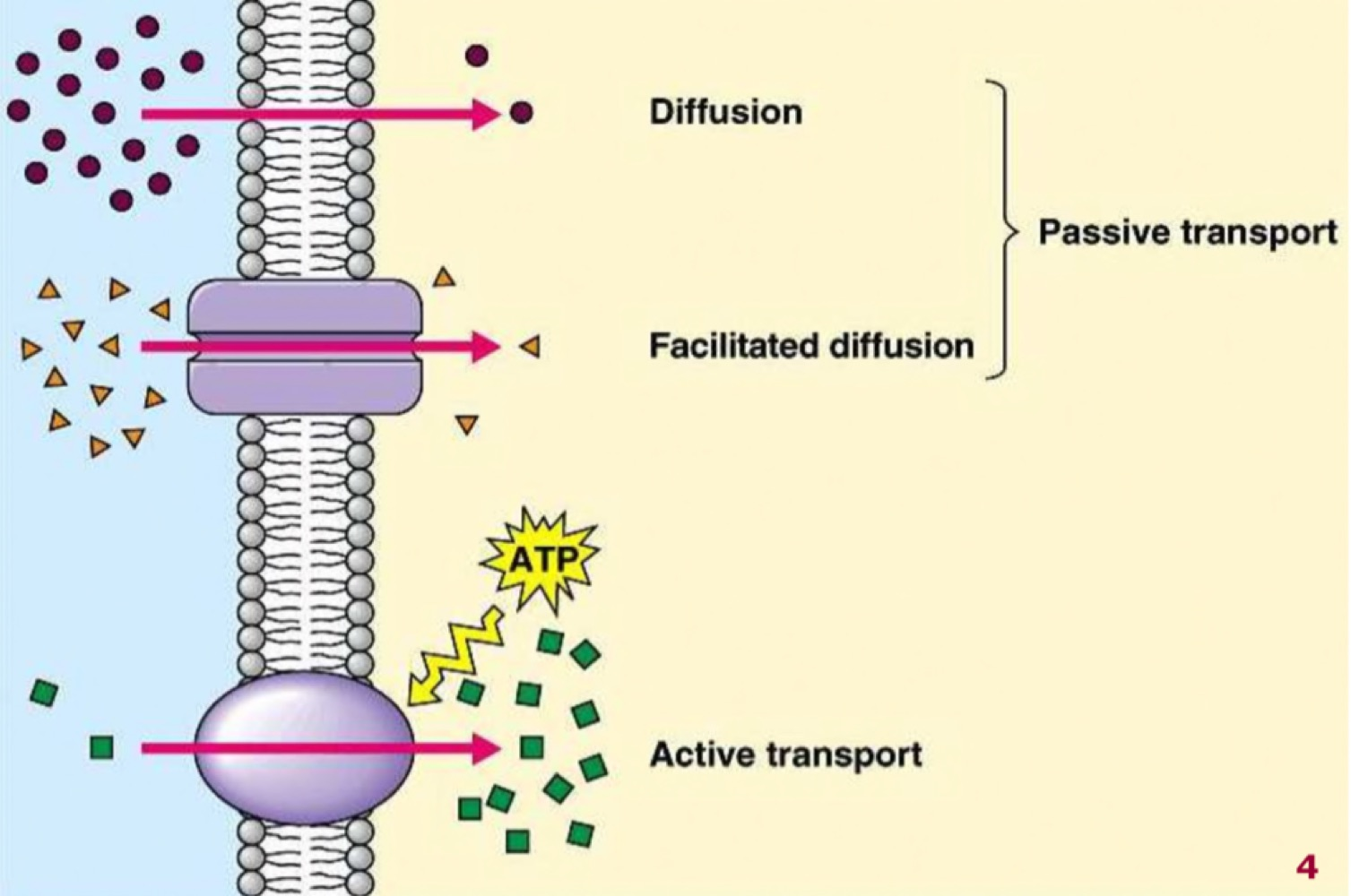
Passive transport does not require energy. There are three kinds.

Diagram of a membrane showing diffusion and facilitated diffusion grouped as passive transport, and below them active transport driven by ATP

Simple diffusion

note

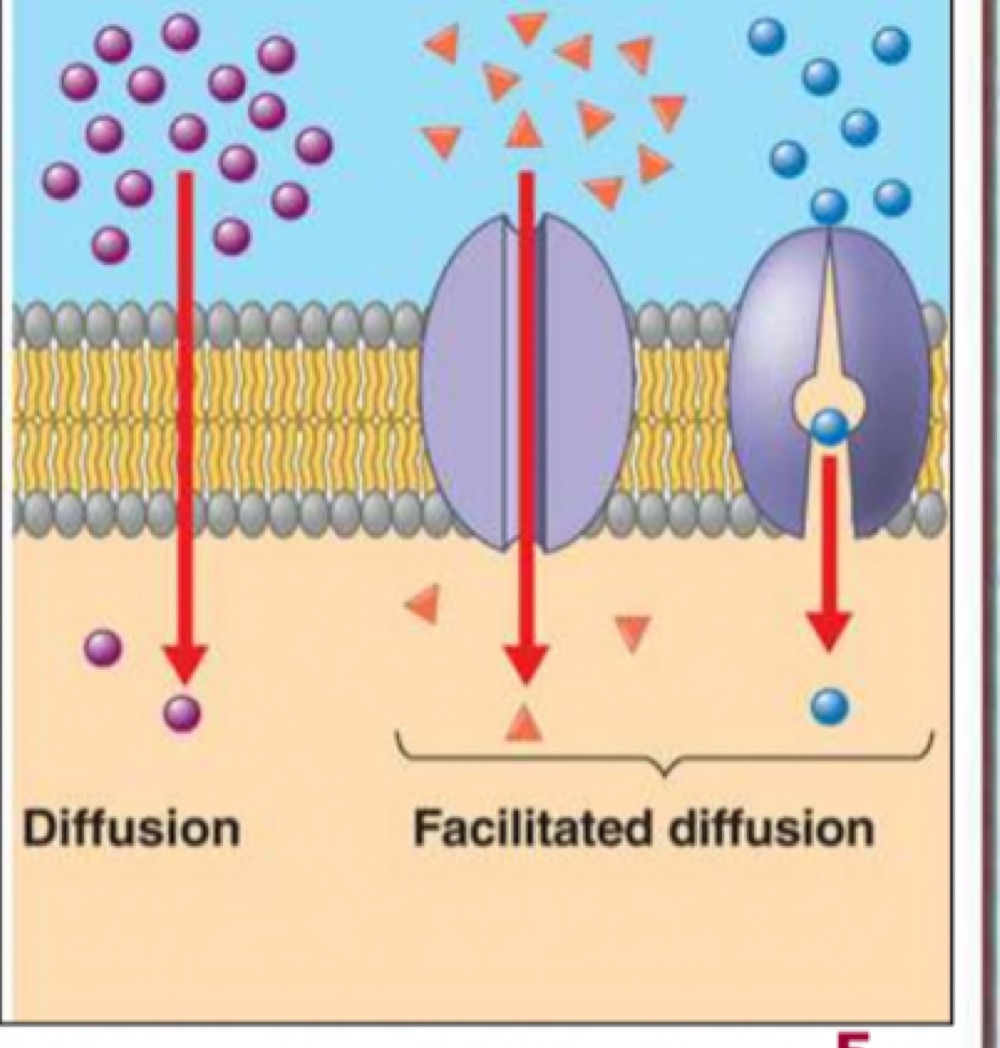
Simple diffusion is the transport of small, non-polar, hydrophobic molecules down their concentration gradient, through the lipid bilayer.

Such a substance diffuses readily. No protein is involved at all: the molecule dissolves into the lipid and comes out the other side.

Facilitated diffusion

note

Facilitated diffusion is the transport of ions and small polar molecules down their concentration gradient, assisted across the semipermeable membrane by a transport protein.

It is of two kinds:

  • Channel-mediated: multipass proteins forming a protein channel through which the substance passes.
  • Carrier-mediated: movement facilitated by a transmembrane protein that binds to it.

The protein is needed because ions and polar molecules cannot cross the hydrophobic core of the bilayer on their own. It supplies a route, not a push, which is why this is still passive.

Diagram contrasting diffusion straight through the bilayer with facilitated diffusion through two membrane proteins

Osmosis

note

Osmosis is the diffusion of water across a selectively permeable membrane.

Movement runs from higher to lower concentrated region and continues until equilibrium is reached.

There are three types of solution:

SolutionMeaning
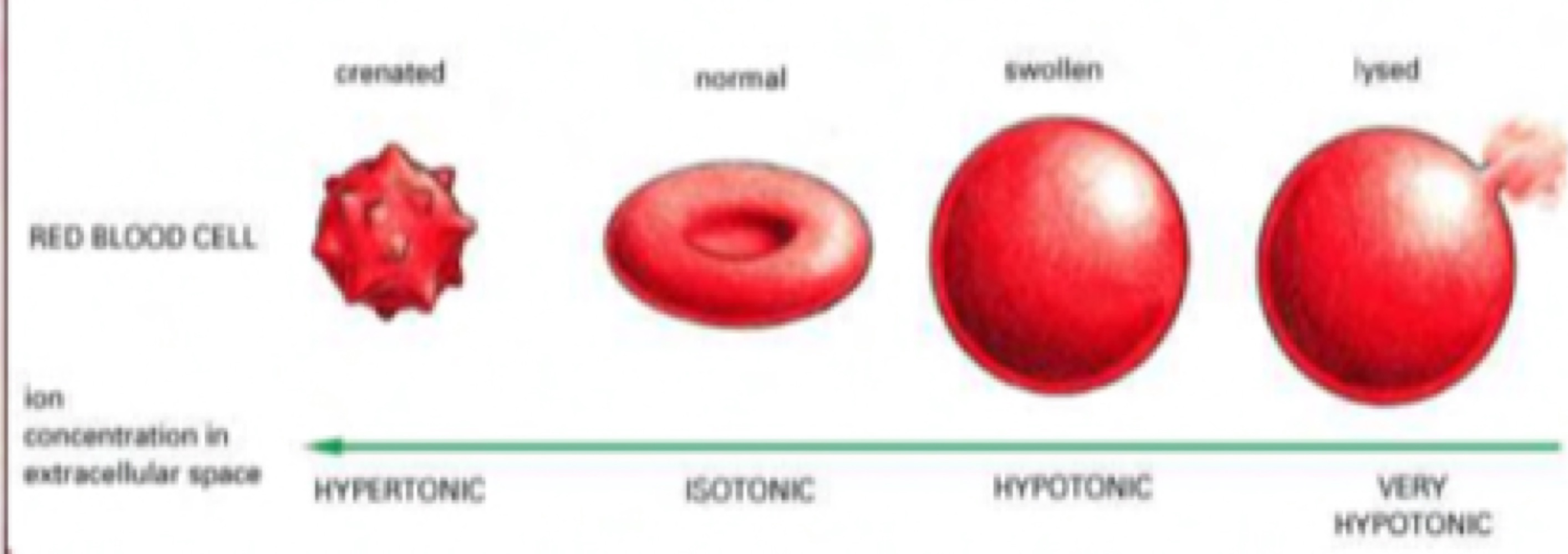
IsotonicEqual concentration on both sides, outside and inside the cell
HypotonicOutside less than inside
HypertonicOutside greater than inside

Hypo and hyper are the pair students most often reverse. Read them as statements about the outside: hypotonic means the outside is the weaker solution, so water enters the cell.

Four red blood cells shown crenated, normal, swollen and lysed as the ion concentration of the surrounding fluid falls from hypertonic through isotonic to very hypotonic

3. Active transport

note

Active transport is the transport of small molecules and ions across the membrane against the concentration gradient, by transmembrane protein pumps. It requires energy.

Primary active transport

note

Primary active transport is the movement of substances across the membrane, powered directly by ATP.

It requires ion channels or ion pumps. Two examples:

  • Ca²⁺ pumps transport Ca²⁺ out of the cell, the calcium pump.
  • 3 Na⁺ out of the cell and 2 K⁺ into the cell, the sodium potassium pump.

Secondary active transport

note

Secondary active transport is coupled transport, or cotransport.

It is the movement of a substance up its concentration gradient, powered by harnessing the movement of a second substance down its concentration gradient. It uses the electrochemical gradient as energy, and so does not require ATP directly.

The word directly is doing real work there. The gradient the second substance runs down was itself built by a pump using ATP, so secondary transport is still paid for by ATP, just not at the moment it happens.

There are two types of cotransport:

  • Symport: two substances are simultaneously moved in the same direction, for example the Na⁺ glucose transporter.
  • Antiport: two substances are simultaneously moved in opposite directions, for example Na⁺ H⁺ transport.
Diagram comparing primary active transport, in which a pump driven by ATP moves sodium out and potassium in, with secondary active transport, in which glucose enters alongside sodium

All 95 Cytology topics · exam study support, not clinical guidance. SuperMed is not affiliated with the Medical University of Sofia.

Start free. No card needed.

Every account starts free, with free topics in Cytology and Medical Biology. Super opens the rest. Super is €15 a month.

Create a free account