



Cytology · Year 1 · Medical University of Sofia

14

Cell membrane. Glycocalyx. Cell membrane models

Free notes for topic 14 of the Cytology syllabus, open without an account. Written by a senior student against the syllabus question and checked line by line by a second student before publishing. How content is made

Updated

The short version

note

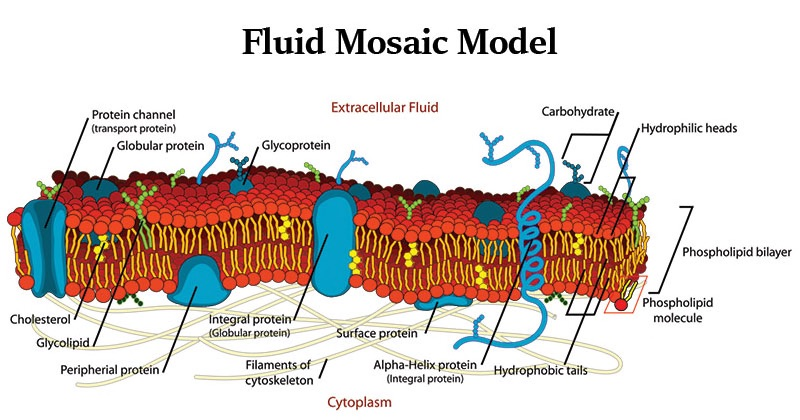
The common cell membrane model is the Fluid Mosaic Model, proposed in 1972 by Singer and Nicolson.

Its basic components by proportion are proteins 50 per cent, lipids 20 to 40 per cent and carbohydrates 10 per cent. The lipid is a phospholipid bilayer with hydrophilic phosphate heads and hydrophobic lipid tails; the proteins are integral or peripheral.

The glycocalyx is the covering that surrounds the cell membrane, made of lipids, glycoproteins and proteoglycans, and it does the jobs that face outwards: protection, absorption, immunological role, cell adhesion and cell recognition.

Four models preceded or produced the current one: Overton 1880, Gorter and Grendel 1925, Danielli and Davson, and Singer and Nicolson 1972.
1. The cell membrane and its components

note

The common cell membrane model is that of the Fluid Mosaic Model, 1972, by Singer and Nicolson.

Its basic components are lipids, proteins, filaments of cytoskeleton and carbohydrates.

Lipids, 20 to 40 per cent

note

  • The phospholipid bilayer, with a hydrophilic phosphate head, which is polar, and hydrophobic lipid tails, which are non-polar.
  • Glycolipids.

Proteins, 50 per cent

note

  • Integral proteins are permanently embedded within the membrane.
  • Peripheral proteins interact on the surface, in temporary connection with the membrane.

Within these:

  • structural proteins are hydrophobic;
  • receptors and enzymes are hydrophilic.

Also present are the filaments of the cytoskeleton.

Carbohydrates, 10 per cent

note

  • glycoproteins;
  • glycolipids;
  • glycocalyx.

Functions of the cell membrane

note

  • physical barrier;
  • selective permeability;
  • communication;
  • electrochemical gradients.

2. The glycocalyx

note

The glycocalyx, also called the cell coat or glycolemma, is a covering that surrounds the cell membranes of some bacteria, epithelia and other cells.

Its composition:

  • lipids: phospholipids, glycolipids and cholesterol;
  • glycoproteins;
  • proteoglycans.

Functions of the glycocalyx

note

  • protection;
  • absorption;
  • immunological role, identifying antigens on the surface of the cell membrane;
  • cell adhesion, binding cells together so that tissues do not fall apart;
  • cell recognition, of foreign particles.

Every one of those is a job that has to be done at the outside surface, which is what the glycocalyx is: the layer where the cell meets everything that is not itself.

3. Cell membrane models

note

Four models, in order.

1880, Overton's theory: that the membrane is an impregnated barrier layer.

1925, Gorter and Grendel model: phospholipids in a lipid bilayer.

Danielli and Davson 'sandwich' model: two protein layers peripherally, with the lipid bilayer centrally. It has a hydrophilic outside pole and a hydrophobic inside pole.

1972, Singer and Nicolson: the fluid mosaic model.

Diagram of the fluid mosaic model showing the phospholipid bilayer with integral and peripheral proteins, glycoproteins and cholesterol

All 95 Cytology topics · exam study support, not clinical guidance. SuperMed is not affiliated with the Medical University of Sofia.

Start free. No card needed.

Every account starts free, with free topics in Cytology and Medical Biology. Super opens the rest. Super is €15 a month.

Create a free account