



Cytology · Year 1 · Medical University of Sofia

33

Cell signalling. Types of receptors. Growth factors

Free notes for topic 33 of the Cytology syllabus, open without an account. Written by a senior student against the syllabus question and checked line by line by a second student before publishing. How content is made

Updated

The short version

note

Cells communicate with one another in order to regulate tissue and organ development, control their growth and division, and coordinate their functions and cell actions.

There are 2 ways of signalling: by a secreted signalling molecule, and by membrane-bound molecules.

There are 5 kinds of communication: endocrine through the bloodstream, paracrine to nearby cells, synaptic across a synapse, juxtacrine by direct physical contact, and autocrine back onto the same cell.

Receptors come in 2 classes: cell surface receptors for hydrophilic signalling molecules, and intracellular receptors for hydrophobic ones that can cross the membrane themselves.
1. Why cells signal

note

Cells communicate with one another:

  • to regulate tissue and organ development;
  • to control their growth and division;
  • to coordinate their functions and cell actions.

2. Two ways of signalling

note

Signalling by a secreted signalling molecule. The target cell uses its receptors to detect and respond to these extracellular signalling molecules.

Signalling by membrane-bound molecules. Many adjacent cells form communicating gap junctions, which couple cells and allow exchange of ions and small molecules.

3. Five kinds of communication

note

Endocrine signalling. The cell releases hormones into a blood vessel, which get transported through the bloodstream to the target cell.

Paracrine signalling. The signals released by the signalling cell bind to receptors of target cells close to the signalling cell.

Synaptic signalling. A nerve cell transports neurotransmitter to the synapse, where the neurotransmitter is released and binds to the receptors of the target cell by synaptic vesicles.

Juxtacrine signalling. Direct physical contact between signalling and target cell. The signalling molecules of the signalling cell bind directly to the receptor of the target cell.

Autocrine signalling. It targets itself. The cell secretes a hormone or chemical messenger that binds to receptors on that same cell.

The five differ only in how far the signal travels: through the whole body, to a neighbour, across a synapse, by touching, or nowhere at all.

4. Receptor types

note

There are 2 classes.

Cell surface receptors. Hydrophilic signalling molecules bind to receptors on the surface, and then initiate a response in the target cell.

Intracellular receptors. Hydrophobic signalling molecules diffuse across the plasma membrane and then bind to intracellular receptors.

The split follows from the membrane itself. A hydrophilic molecule cannot cross the lipid core, so its receptor has to be on the outside; a hydrophobic one can, so its receptor can be inside.

Channel-linked receptors

note

Channel-linked receptors are ion channels found on integral membrane proteins.

When a ligand binds to the integral protein, the ion channel opens, so that ions or molecules pass across it, for example neurotransmitters.

Enzymatic receptors

note

With enzymatic receptors, a ligand binds to the receptor and this induces catalytic activity.

  • They have a major role in growth processes and proliferation, that is fast growth.
  • They are involved in rapid cytoskeleton movements.

5. Growth factors

note

Growth factors are substances stimulating cellular growth and healing.

An example is the tyrosine kinases, which are enzyme receptors.

6. Cell reactivity

note

Cell reactivity is the capability to respond to changes in the cell environment, such as temperature and antigens.

Cells receive signals, that is they get activated, and will be excited and respond to changes by:

  • contraction;
  • movement;
  • immune response;
  • depolarisation of the membrane.

7. Cell motility

note

Cell motility is the ways a cell can move from one point to another.

Movement towards a stimulus has a name for each kind of stimulus:

StimulusName
A chemical substanceChemotaxis
A light stimulusPhototaxis
A water flow stimulusRheotaxis

Each can be positive, which is attraction, or negative, which is repulsion.

Three types of cell movement

note

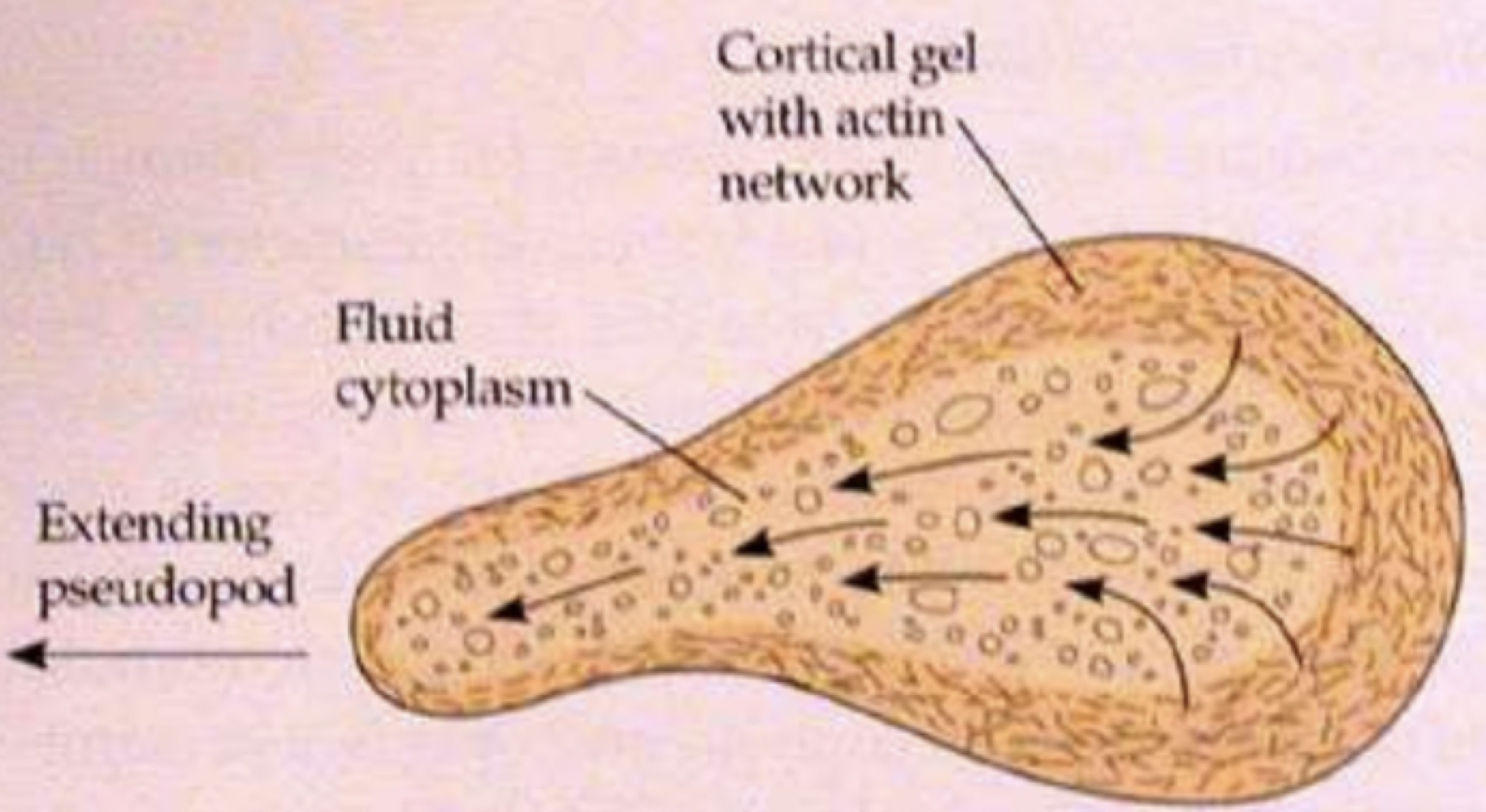
Ameboid movement, or migration, is a crawling-like type of movement, accomplished by forming pseudopods by actin and myosin filaments, in the presence of ATP.

Movement of cilia and flagella: energy and movement are generated by the basal body.

Muscle contraction is done by actin and myosin filaments, the kinetic centre. Muscle contraction includes the sliding filament theory.

Diagram of a crawling cell showing the extending pseudopod, the fluid cytoplasm and the cortical gel with its actin network

All 95 Cytology topics · exam study support, not clinical guidance. SuperMed is not affiliated with the Medical University of Sofia.

Start free. No card needed.

Every account starts free, with free topics in Cytology and Medical Biology. Super opens the rest. Super is €15 a month.

Create a free account