



Cytology · Year 1 · Medical University of Sofia

20

Golgi apparatus

Free notes for topic 20 of the Cytology syllabus, open without an account. Written by a senior student against the syllabus question and checked line by line by a second student before publishing. How content is made

Updated

The short version

note

The Golgi apparatus, named after Camillo Golgi in 1898, is a dynamic organelle complex that completes the posttranslational modifications of proteins produced by the RER. It then packages, sorts and addresses those proteins to their proper destination.

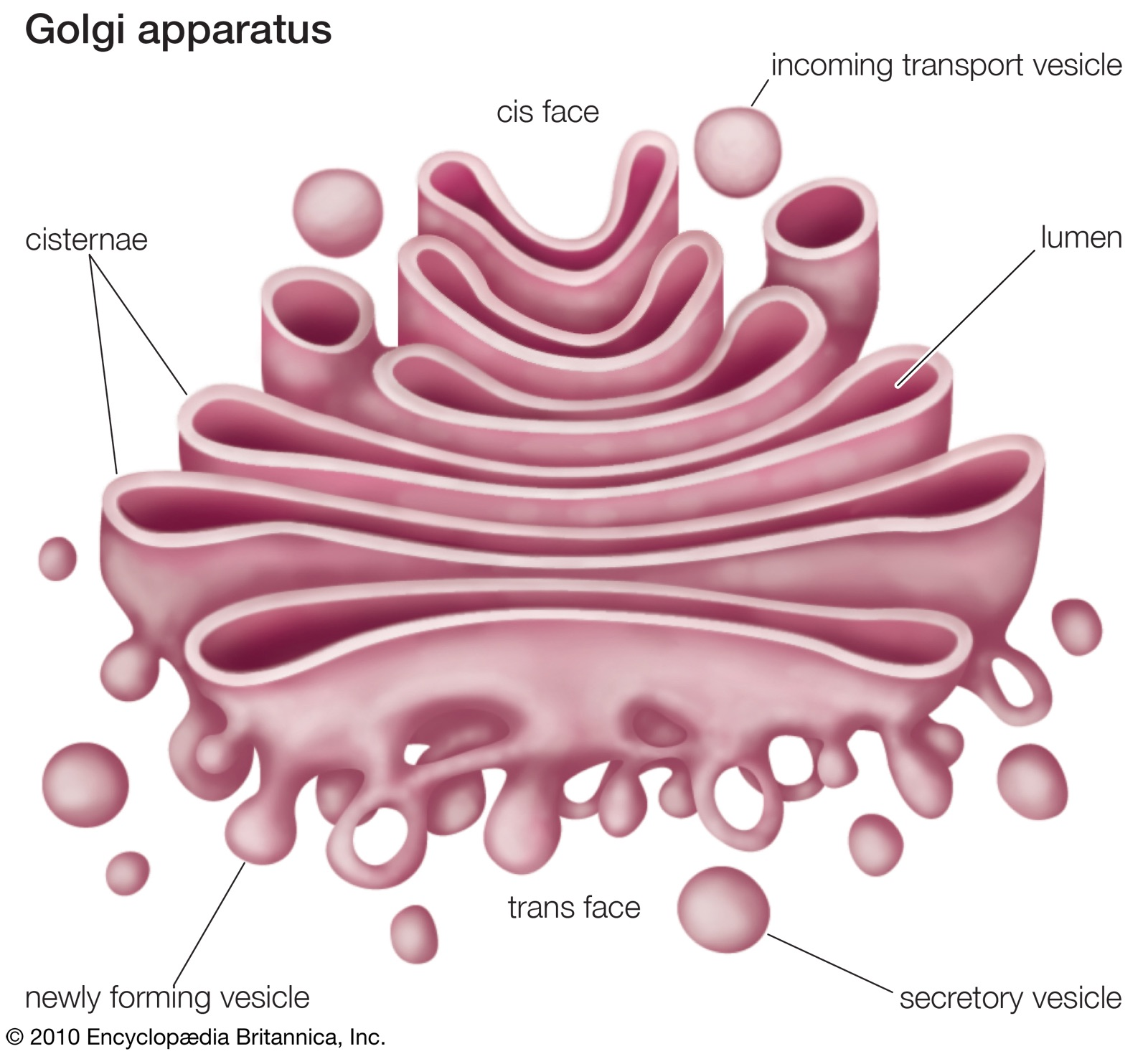
It has two faces and they are not interchangeable. The cis face is the receiving region, adjacent to the endoplasmic reticulum, where material arrives from the RER cisternae in transport vesicles. The trans face is the shipping side, where larger saccules accumulate, condense and generate the vesicles that carry protein products away.

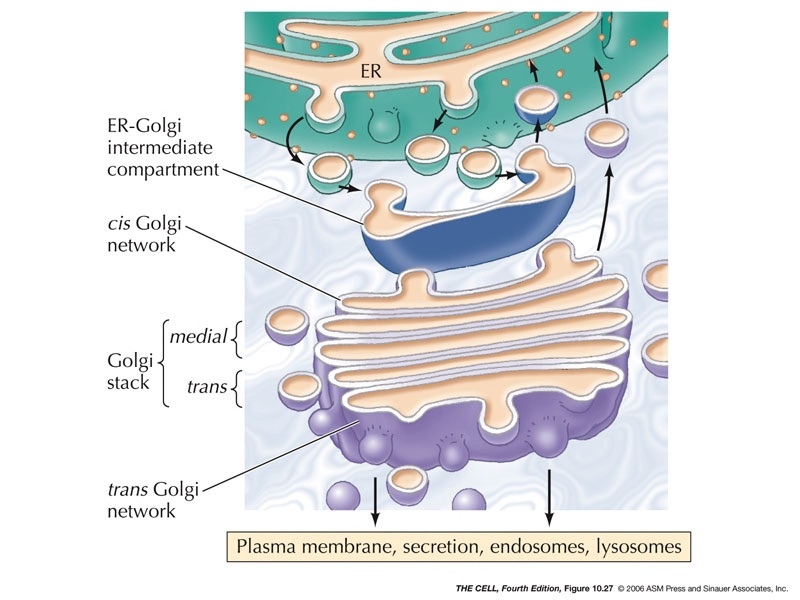
Movement through the stack is guided by coat proteins: COP II for anterograde, COP I for retrograde.
1. What the Golgi apparatus is

note

The Golgi apparatus is named after Camillo Golgi, 1898.

  • It is a dynamic organelle complex that completes the posttranslational modifications of proteins produced by the RER.
  • It packages, sorts and addresses these proteins to their proper destination.
  • It consists of smooth membranous saccules, vesicles and flattened cisternae.

The verb addresses is the one to notice. The Golgi is not simply a finishing step; it decides where each protein goes.

Diagram of the Golgi apparatus showing the cis face receiving an incoming transport vesicle, the cisternae and lumen, the trans face, a newly forming vesicle and a secretory vesicle

2. Morphology and function: the two faces

note

The cis face is the Golgi receiving region, adjacent to the endoplasmic reticulum site. Material moves from the RER cisternae to the Golgi apparatus in transport vesicles.

The trans face is the opposite, shipping side. Here larger saccules accumulate, condense and generate other vesicles that carry protein products to organelles away from the Golgi.

So a protein enters at cis and leaves at trans, and the two faces are structurally different because they are doing opposite jobs.

3. Coat proteins and direction

note

Vesicle movement through the Golgi apparatus is guided by coat proteins:

  • Anterograde movement, forwards, by COP II.
  • Retrograde movement, backwards, by COP I.

The pair is easy to reverse under pressure. COP II carries material onward; COP I brings it back.

4. Leaving the Golgi

note

Modified proteins leave the Golgi apparatus after getting packaged in vesicles with coat proteins.

From there the movement is to:

  • lysosomes;
  • the plasma membrane;
  • secretion by exocytosis.
Diagram of the secretory pathway from the endoplasmic reticulum through transport vesicles and the intermediate compartment to the cis, medial and trans Golgi network, and on to the plasma membrane, secretion, endosomes and lysosomes

All 95 Cytology topics · exam study support, not clinical guidance. SuperMed is not affiliated with the Medical University of Sofia.

Start free. No card needed.

Every account starts free, with free topics in Cytology and Medical Biology. Super opens the rest. Super is €15 a month.

Create a free account